Healthy & Smart Home12 min read
Circadian Lighting at Home: Tunable LEDs, Flicker, and Cove Lighting (2026 Cost and Design Guide)
Circadian lighting at home in 2026: tunable white LEDs, what the research supports, flicker and color specs, cove lighting with Level 5 walls, and Lubbock costs.
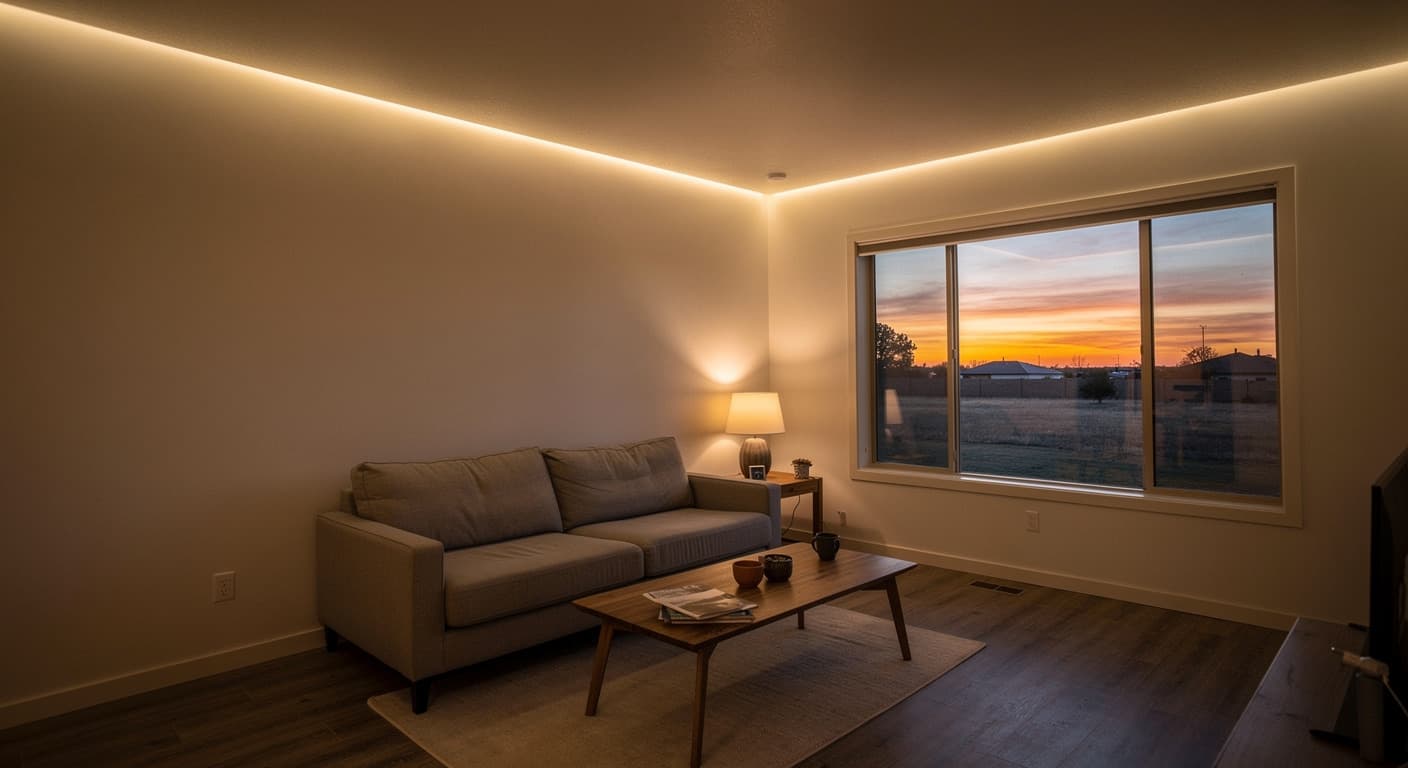
Circadian lighting at home is tunable LED lighting that runs bright and cooler white during the day and dim and warm in the evening, and adding it with LED cove lighting in one to a few rooms typically costs $2,000 to $12,000 in Lubbock in 2026. A whole-home system runs higher. What most sales pitches skip is that brightness at your eyes and timing matter as much as color, and that a cheap driver can add flicker that undercuts the whole idea. This guide covers what the research supports, the flicker and color specs worth demanding, how cove lighting and wall finishes work together, and what drives the price.
On this page
- 01What Circadian Lighting Costs in Lubbock (2026)
- 02What Circadian Lighting Is, and What It Is Not
- 03What the Research Actually Supports
- 04Flicker: The Spec Most Tunable Products Leave Out
- 05Color Rendering: CRI 90 and R9 Matter More Than the Kelvin Number
- 06Layers: Cove and Wall-Wash Ambient, Task, and Accent
- 07Controls and Scenes That Follow the Sun
- 08The Lubbock Factor: Big Sky Days, 9 p.m. Sunsets, and Dark Bedrooms
- 09Retrofit vs New Construction, and Why Level 5 Walls Matter
- 10How to Get an Accurate Quote
- 11A Note from Nextgen Blueprint
- 12Frequently asked questions
What Circadian Lighting Costs in Lubbock (2026)
Cost depends on how many rooms you tune, whether fixtures are new or retrofits, and how much control you want. These 2026 Lubbock budgets build on national figures of about $125 to $300 per standard recessed light in an existing ceiling, electrician rates of $40 to $100 an hour, and $7 to $16 per linear foot for crown-style molding, adjusted for tunable fixtures, drivers, and programming.
- Cove lighting, one to a few rooms
- $2,000 to $12,000
- Tunable downlight, installed
- $200 to $450
- Whole-home system
- $10,000 to $30,000+
| Project | Installed cost | What it covers |
|---|---|---|
| Tunable smart bulbs and lamps | $50 to $150 per room | Screw-in bulbs for lamps and existing fixtures |
| Tunable-white downlights | $200 to $450 per light | New or retrofit downlights on compatible controls |
| Cove lighting, one room | $2,000 to $5,000 | Tunable tape, channel, drivers, controls, and the cove detail |
| Cove lighting, several rooms | $5,000 to $12,000 | Multiple coves or wall-wash runs on shared scenes |
| Whole-home tunable system | $10,000 to $30,000+ | Downlights, coves, and programmed scenes throughout |
What Circadian Lighting Is, and What It Is Not
Circadian, or human-centric, lighting is a design approach rather than a product. The hardware is usually tunable white LEDs, which blend warm and cool channels so one fixture can shift from about 2700K, the color of a warm incandescent bulb, to 5000K or higher, closer to midday daylight. Warm-dim fixtures are a simpler cousin that only get warmer as they dim.
The idea rests on how the body keeps time. Light is the main daily cue for the internal clock, and the eye cells that carry that signal respond most to blue-rich light. So brightness at the eye, spectrum, timing, and duration all matter, and Kelvin is only a rough stand-in for spectrum. Circadian lighting is not a medical treatment, and a lighting system will not fix a sleep problem on its own.
What the Research Actually Supports
The most useful single reference is a 2022 expert consensus in PLOS Biology by Brown and colleagues. It sets targets for healthy adults on regular daytime schedules, measured at the eye in the vertical plane about 4 feet off the floor, in melanopic EDI, a unit that weights light by how strongly it drives those clock-signaling cells.
Three practical points follow. Indoor lighting built to current guidelines is typically at least ten times dimmer than daylight outdoors, and ordinary lighting often falls short of the daytime target, so daylight and bright daytime settings matter more than bulb color. Many standard 2700K to 3000K LEDs, kept dim, already meet the evening target. And two sources with the same color temperature can differ a lot in melanopic effect, so a Kelvin number is not a circadian spec. The targets:
- Daytime: at least 250 melanopic lux at the eye, from daylight wherever possible.
- Evening, starting at least three hours before bed: no more than 10 melanopic lux.
- Sleep: as dark as possible, no more than 1 melanopic lux.
Flicker: The Spec Most Tunable Products Leave Out
LEDs run on drivers, and a driver that lets its output ripple makes the light pulse many times a second. You may not notice it directly, but it shows up as shimmer on phone video, a trail of separate images when you move your eyes or wave a hand, and for sensitive people as plain discomfort. It often gets worse as the light dims, which matters when circadian scenes spend every evening dimmed.
The usual benchmark is IEEE 1789, a 2015 recommended practice that IEEE moved to inactive-reserved status in March 2026 but that remains widely cited. Its low-risk rule keeps percent flicker below 0.08 times the flicker frequency, about 10 percent at 120 Hz, the most common flicker rate on 60 Hz household power, with a stricter 0.0333 multiplier for especially sensitive viewers and no low-risk limit at 1,250 Hz or higher. A Department of Energy presentation on the standard lists LEDs with simple, inexpensive drivers, phase-cut (triac) dimming, and pulse-width modulation as more likely to flicker. California's JA8 standard sets a looser floor of under 30 percent below 200 Hz, tested at full and 20 percent output. To check:
- Film the light with your phone, ideally in slow motion, and look for rolling bands. Dim it and check again. A clean picture is encouraging, not proof.
- Wave a pencil under the light. A smooth blur is good; a row of ghost images means flicker.
- Ask for percent flicker at full and dimmed output on the spec sheet.
- Use a driver and dimmer pairing the manufacturer lists as compatible, and skip bargain tape light with an unbranded power supply.
Color Rendering: CRI 90 and R9 Matter More Than the Kelvin Number
Color rendering is how natural colors look under a light. CRI averages how a source renders eight pastel test colors and leaves out saturated red, which is scored separately as R9, so a lamp can claim CRI 90 and still make skin, wood floors, and food look flat. Ask for CRI 90 or higher and R9 of 50 or more, the floor California's JA8 standard uses for residential light sources. Tunable products add a consistency question: whether color matches from fixture to fixture and across the tuning range, often listed in MacAdam steps, where 2 or 3 is tight.
Layers: Cove and Wall-Wash Ambient, Task, and Accent
Because the research measures light at the eye, walls and ceilings do much of the work. Cove lighting bounces light off the ceiling and wall-wash fixtures spread it down a wall, putting more light into your field of view than downlights aimed at the floor, with less glare. Those layers carry the schedule:
- Ambient: cove, wall-wash, and a few downlights on tunable control, bright and cooler by day, warm and low at night.
- Task: under-cabinet lights, vanity lights at face height, and reading lamps, bright for the job and dimmable later.
- Accent: art and shelf lighting that adds depth without much added brightness.
- Night: low, warm path lights near the floor, so a 2 a.m. trip needs no overheads.
Controls and Scenes That Follow the Sun
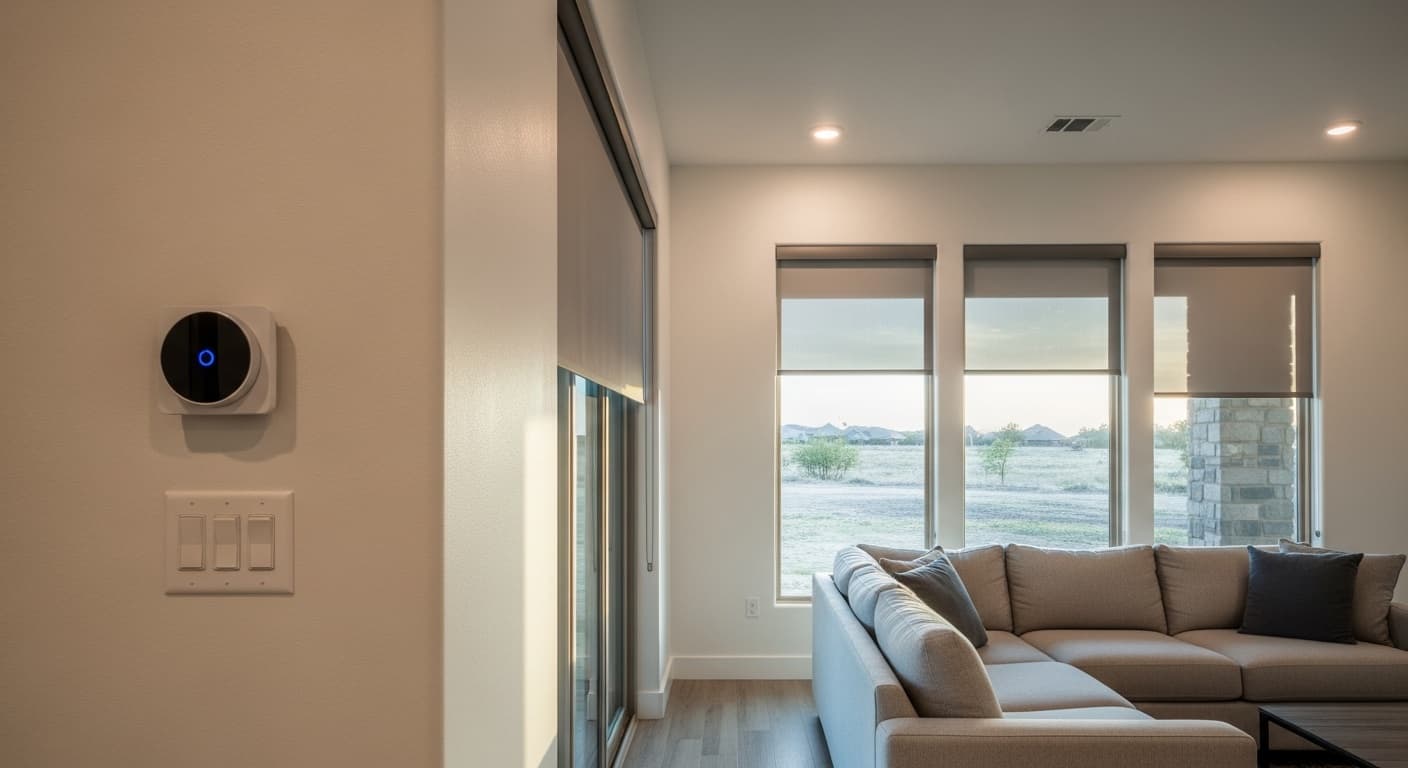
Controls are what make tunable fixtures circadian. Options run from app-controlled bulbs, to tunable fixtures on a two-channel driver with a wall control, to a whole-home system running scenes on an astronomic clock. Favor wall controls everyone in the house can use, keep an override one button away, and key scenes to sunrise, sunset, and bedtime rather than fixed hours. Our smart home team programs a typical schedule like this:
- Wake: a 20 to 30 minute ramp to bright, cooler white in the kitchen and baths.
- Day: 4000K to 5000K ambient where daylight is thin, with windows doing the rest.
- Evening: about three hours before bed, drop to 2700K or warmer and dim the ambient layer.
- Night: dark bedrooms, with dim, warm path lights on motion sensors.
- Overrides: one button each for cleaning, movie night, or a late dinner.
The Lubbock Factor: Big Sky Days, 9 p.m. Sunsets, and Dark Bedrooms
West Texas gives most houses more daylight than they use. Even a cloudy morning outdoors is typically far brighter than a well-lit room, so the cheapest circadian upgrade here is often a breakfast table by an east window or coffee on the porch. The catch is that many Lubbock houses spend summer afternoons with the blinds drawn against the west sun, so interiors can stay dim on the brightest days, and bright daytime ambient light earns its place.
Summer evenings run long. Lubbock sits on the western side of the Central time zone, so in late June the sun sets around 9:00 p.m., twilight lasts until about 9:30, and solar noon lands near 1:50 p.m. A fixed 7 p.m. evening scene would fight daylight still pouring through the windows, which is why scenes should follow sunset and bedtime. Winter flips it: in early January the sun does not rise until about 7:52 a.m., so a bright wake-up scene earns its keep on dark school mornings.
That early summer light also makes bedroom darkness half the plan. Civil twilight starts around 6:08 a.m. in late June, and street and security lights run all night, so bedrooms need blackout shades or lined drapes to get near the 1 lux sleep target, and no bright standby lights inside.
- Late June sunset
- about 9:00 p.m.
- Early January sunrise
- about 7:52 a.m.
- Sleep-time target
- 1 melanopic lux or less
Retrofit vs New Construction, and Why Level 5 Walls Matter
New construction is the easy case: coves get framed into the ceiling plan, drivers go where you can reach them later instead of behind finished drywall, and control wiring runs while the walls are open. Retrofits work too, using surface-mounted cove molding or plaster-in aluminum channels, tunable downlights sized for existing cans, and wireless controls. In Lubbock, swapping a fixture on existing wiring generally needs no permit, but new circuits or new line-voltage wiring do, and our electrical team pulls that permit as part of the job.
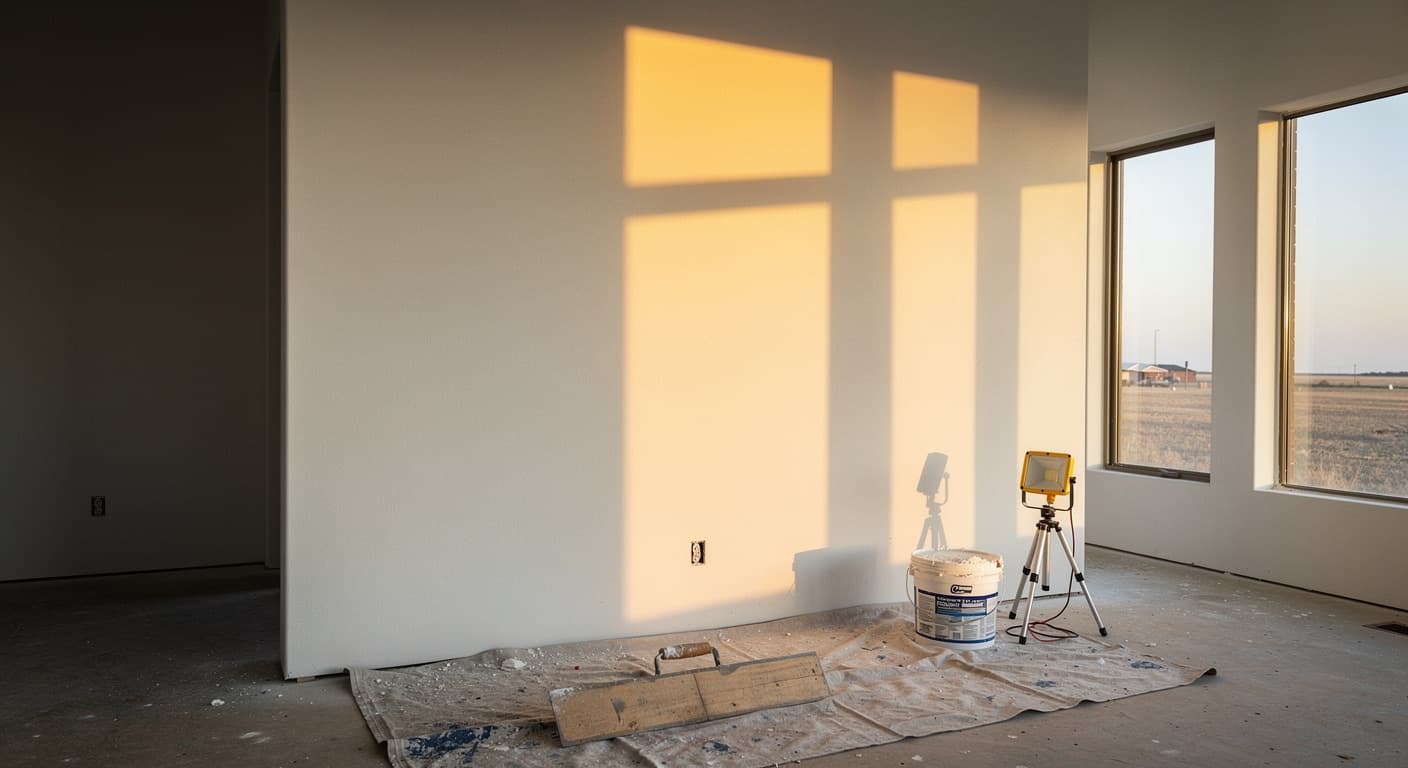
Cove and wall-wash light rake across surfaces at a low angle, the kind of critical lighting where the Gypsum Association's GA-214 standard says a Level 5 finish is typically specified: a skim coat over the entire surface, so joints and fasteners do not show through paint. Plan it for the ceiling above a cove and walls under wall-washers, with flat or low-sheen paint. In Lubbock, Level 5 typically adds about $1.00 to $1.75 per square foot of surface in new construction, and skimming existing textured walls runs about $1.50 to $3.50 per square foot. Our Level 5 drywall finish guide covers the details.
How to Get an Accurate Quote
Two fixtures that look alike on paper can perform very differently. For a ballpark first, our free instant estimate returns a range in under a minute. For real quotes, ask for:
- A room-by-room plan for morning, afternoon, and evening use.
- Linear feet of cove or wall-wash, the downlight count, and where drivers will live.
- Spec sheets showing tuning range, CRI and R9, and percent flicker at full and dimmed output.
- Confirmation that the drivers, dimmers, and controls are listed as compatible.
- Who programs the scenes and how you change them later.
- The drywall finish level, paint, and any permit, included or priced separately.
A Note from Nextgen Blueprint
This guide was researched and published by Nextgen Blueprint, a Lubbock design-build contractor that builds circadian lighting into new homes and remodels as part of its healthy living systems, with the electrical, drywall, and programming handled by one team. Treat these numbers as 2026 Lubbock-market ranges to budget with, not a quote, since the real figure depends on how many rooms you tune, the fixtures and controls you choose, and the wall and ceiling finish. The pricing and research summaries were accurate as of September 2026. Get a written, itemized estimate, and ask for flicker and color data on every fixture before you commit.
Frequently asked questions
What is circadian lighting for a home?
How much does circadian lighting cost in Lubbock?
Does circadian lighting actually work?
What color temperature should lights be at night?
How can I tell if my LED lights flicker?
What CRI should I look for in LED lighting?
Can I add circadian lighting to an existing home?
Do I need a Level 5 drywall finish for cove lighting?
Sources and further reading
- [1]Brown et al., Recommendations for indoor light exposure, PLOS Biology (2022)
- [2]U.S. DOE, Flicker: Understanding the New IEEE Recommended Practice
- [3]Energy Code Ace, California JA8 Light Source Requirements
- [4]Gypsum Association, GA-214-2021 Levels of Finish for Gypsum Panel Products
- [5]HomeGuide, Cost to Install Recessed Lighting
Written by
John Paul, Founder, Nextgen Blueprint
John Paul founded Nextgen Blueprint with his father-in-law, a Lubbock-area general contractor with 30+ years of experience. They build healthy, natural homes for Lubbock families, and approach every project with the kind of care and attention to detail most contractors save for their own home.
More from JohnRelated services
Filed under Healthy & Smart Home. Cleaner water, cleaner air, better light, smarter systems.