Cost Guides12 min read
EV Charger Installation Cost in Lubbock, TX: Level 2, Panels & Permits (2026)
What a home EV charger costs to install in Lubbock in 2026: Level 1 vs Level 2, hardwired vs plug-in, run length, panel capacity and load management, permits, and the end of the 30C credit.
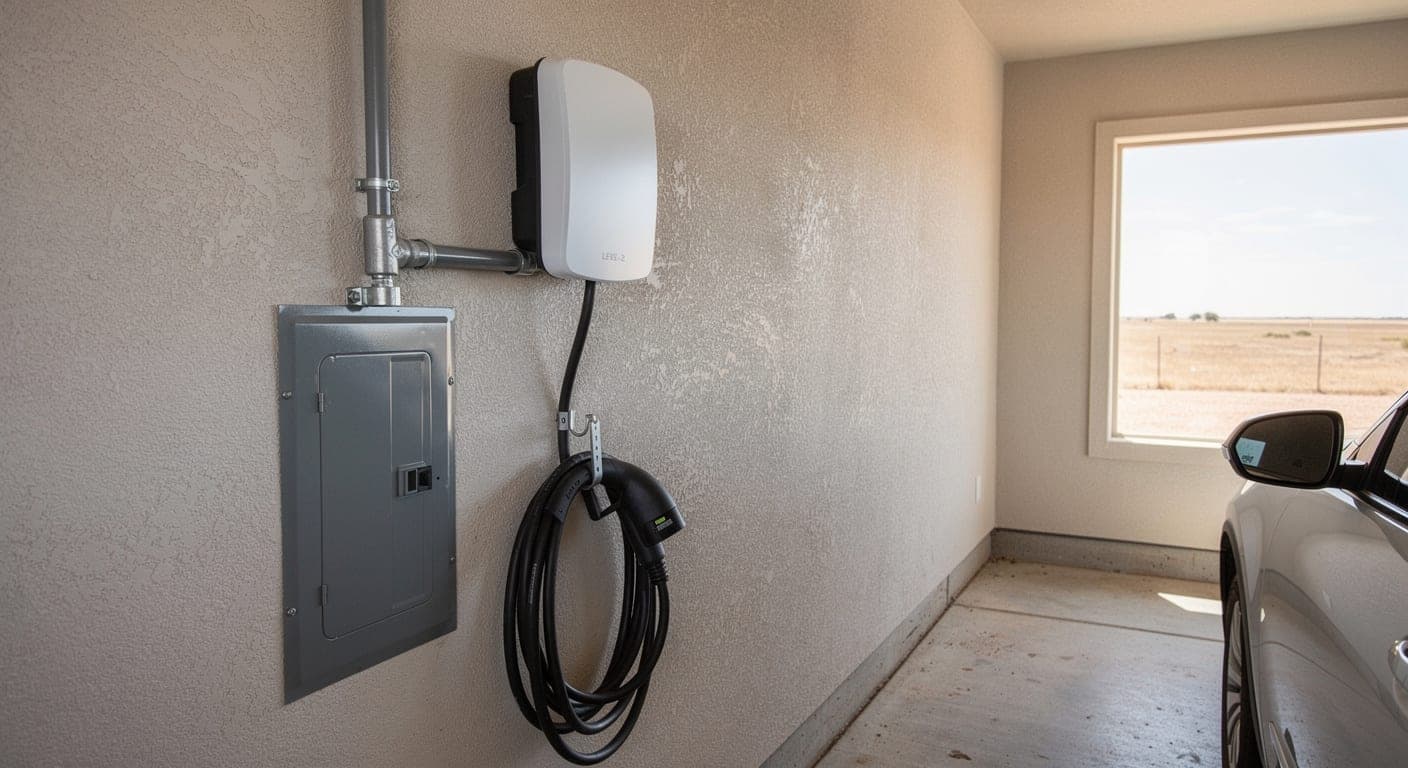
EV charger installation in Lubbock typically costs $800 to $2,500 in 2026 for a Level 2 circuit, plus $300 to $900 for the charger if you are not supplying one. Short runs from a panel on the garage wall land near the bottom, and long runs to a detached garage or an outdoor pedestal land near the top. The price jumps only when the load calculation says your service cannot carry the charger, which is mostly a question for older 100 amp homes. The federal 30C charger credit is gone for equipment placed in service after June 30, 2026, so budget the full cost.
On this page
- 01What EV Charger Installation Costs in Lubbock (2026)
- 02Where the Money Goes on a Level 2 Install
- 03Level 1 vs Level 2: Do You Need a 240-Volt Charger?
- 04Hardwired vs Plug-In, and How Many Amps
- 05Does Your Panel Have Room? Load Calculations and Load Management
- 06The Lubbock Factor: Heat, Dust, Wind, and LP&L
- 07Worked Example: Two Lubbock Garages
- 08Permits, Licensing, and Code in Lubbock
- 09Tax Credits and Rebates for Home Chargers in 2026
- 10How to Get an Accurate EV Charger Quote
- 11A Note from Nextgen Blueprint
- 12Frequently asked questions
What EV Charger Installation Costs in Lubbock (2026)
Most Lubbock homeowners pay for two things: the electrical work, which is a dedicated 240-volt circuit from the panel to the parking spot, and the charger, which you can buy yourself or have the electrician supply. National figures line up with Lubbock pricing. Qmerit, a national installer network, reports 2026 Level 2 installs of $749 to $2,500 with a $1,700 average, and Fixr puts a typical job with the charger at $1,000 to $2,500. Our ranges include the permit and inspection.
- Level 2 charger circuit
- $800 to $2,500
- Charger hardware
- $300 to $900
- 30C credit end date
- June 30, 2026
| Scope | Installed cost | What it covers |
|---|---|---|
| Level 1 on an existing outlet | $0 | The cord that ships with the car, on a dedicated 120-volt circuit |
| Level 2, short run | $800 to $1,300 | Panel on or next to the garage wall, run under about 25 feet |
| Level 2, longer run | $1,300 to $2,000 | Panel across the house, run through an attic or finished walls |
| Level 2, detached garage or outdoor | $2,000 to $2,500 | Long run, trenching, or a post-mounted outdoor unit |
| Charger (hardware) | $300 to $900 | Listed Level 2 unit, plug-in or hardwired |
| Subpanel, if needed | $500 to $1,750 | Small panel and feeder for a garage or shop |
| Service upgrade, if needed | $2,000 to $5,000 | 100 to 200 amp upgrade with permit and LP&L coordination |
Where the Money Goes on a Level 2 Install
Two quotes for the same garage can differ by $1,000 because they price different routes and different equipment. A complete Level 2 quote covers:
- The breaker: a 2-pole 50 amp breaker for a 40 amp charger or a 60 amp breaker for a 48 amp charger, plus a GFCI breaker when the charger plugs into a receptacle.
- Wire and conduit: heavy copper conductors sized for the breaker, the biggest variable on a long run. Fixr prices added run at about $6 to $12 per linear foot.
- The route: surface conduit in an unfinished garage is quick, while fishing wire through finished walls, an attic, or under a slab takes more labor and patching.
- Mounting: a wall mount in the garage, or a post or pedestal and a trench for a driveway or carport spot.
- Permit, inspection, and setting the charger's current limit to match the breaker.
Level 1 vs Level 2: Do You Need a 240-Volt Charger?
Not every EV owner needs Level 2. The Department of Energy's Alternative Fuels Data Center says Level 1, the 120-volt cord that comes with the car, adds about 5 miles of range per hour, or roughly 40 miles over an 8 hour night, and that many drivers meet their daily needs that way with no added cost. Level 1 should still be on a dedicated circuit.
Level 2 runs on 240 volts and adds about 25 miles of range per hour at 7.2 kilowatts, the output the DOE says most residential units deliver on up to 30 amps. Larger 40 and 48 amp chargers go faster. Choose Level 2 if you drive long days, commute from Wolfforth or Shallowater, own two EVs, or have a large battery that Level 1 cannot refill overnight.
| Factor | Level 1 | Level 2 |
|---|---|---|
| Voltage | 120 volts | 240 volts |
| Range added per hour | About 5 miles | About 25 miles at 7.2 kW, more on 40 to 48 amp units |
| Overnight (8 hours) | About 40 miles | A full charge for most EVs |
| Installed cost | $0 on an existing dedicated outlet | $800 to $2,500 plus the charger |
| Best for | Short commutes, plug-in hybrids | Longer drives, big batteries, two-EV homes |
Hardwired vs Plug-In, and How Many Amps
The National Electrical Code treats EV charging as a continuous load, so the circuit is sized at 125 percent of the charger's output: a 40 amp charger on a 50 amp circuit, or a 48 amp charger on a 60 amp circuit. A plug-in charger uses a NEMA 14-50 or 6-50 receptacle, which tops out at a 50 amp circuit and 40 amps of charging.
Since the 2020 code, section 625.54 requires GFCI protection on every receptacle installed for EV charging. That means a 50 amp GFCI breaker, and chargers have their own ground-fault protection, so the two can clash. ChargePoint, for one, recommends hardwiring its Home Flex where code calls for a GFCI breaker on a plug-in install, since the breaker can nuisance trip. Hardwiring also allows more current: the Home Flex accepts breakers from 20 to 80 amps and charges at up to 50 amps.
Plug-in makes sense if you may take the charger with you when you move. Otherwise, hardwired is usually the better Lubbock install.
Does Your Panel Have Room? Load Calculations and Load Management
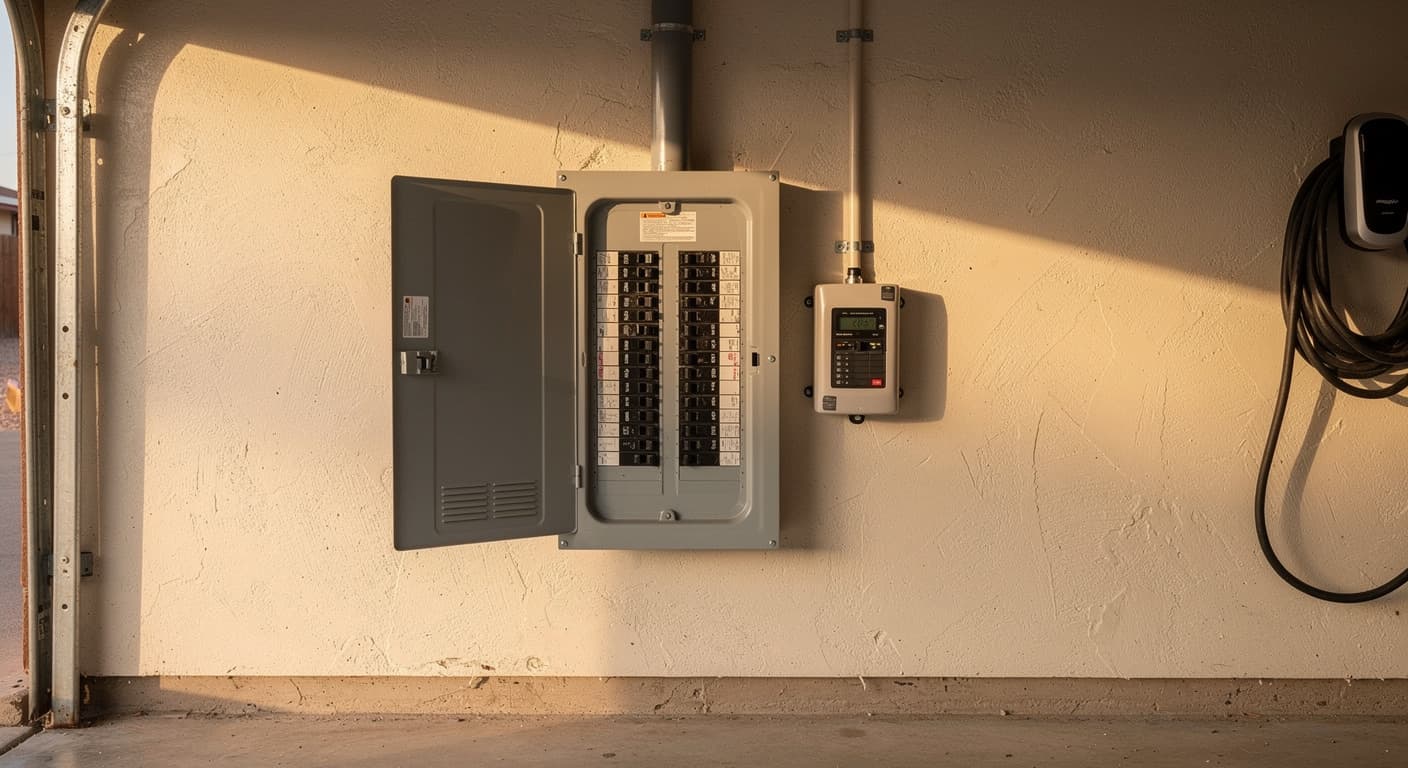
Open breaker slots do not prove there is capacity. A load calculation under the electrical code adds up the home's lighting, kitchen and laundry circuits, fixed appliances, and the larger of heating or cooling, then applies demand factors. A 48 amp charger is about 11.5 kilowatts of continuous load while it runs, and a 40 amp charger about 9.6 kilowatts.
Many 200 amp homes in newer south and southwest Lubbock neighborhoods can carry that. A 100 amp home with central air, an electric range, and an electric dryer often cannot. You then have three options. Turn the charger down: a 32 amp setting on a 40 amp circuit still adds plenty of range overnight. Add load management, which the code recognizes: under 625.42, when an automatic load management system limits the charger, the service is sized to what that system allows. Or upgrade the service, which our electrical panel upgrade cost guide covers in detail.
The Lubbock Factor: Heat, Dust, Wind, and LP&L
Lubbock is hard on outdoor equipment. On March 14, 2025, the National Weather Service recorded an 82 mph gust at Lubbock's airport, the highest spring gust on record there since 1945, with blowing dust cutting visibility to a quarter mile. Summer is the other test: the city's July record is 111 degrees, set in 2020. The DOE says outdoor charging is safe, even in rain, but the equipment must be outdoor rated.
For a driveway or carport charger, look for at least a NEMA 3R enclosure, check the unit's listed operating temperature range, and mount it where the cable will not lie in the driveway. Holster the connector after every use so dust stays out of the handle. Charging in a closed garage keeps the cable out of the sun and wind, which is one reason garage installs are both cheaper and easier on the equipment here.
LP&L still delivers power inside city limits, but since retail choice you buy electricity from a provider you pick. Some plans price power by time of day, and a charger with a schedule can shift charging to cheaper hours. Our guide to smart home upgrades covers energy monitors and time-of-use planning.
- Peak gust, March 14, 2025
- 82 mph
- Lubbock July record high
- 111°F
- Outdoor enclosure minimum
- NEMA 3R
Worked Example: Two Lubbock Garages
Two typical houses show how the range works. The first is a 1990s brick ranch in southwest Lubbock with a 200 amp panel on the attached garage wall. A load calculation shows room for a 48 amp charger, so the electrician runs about 20 feet of conduit to a 60 amp hardwired circuit. The second is a 1960s house near Tech Terrace with a 100 amp panel in a hall closet and a detached garage 60 feet away.
The second house pays for distance, a trench, and capacity. At $6 to $12 a foot, the extra 40 feet of run alone adds roughly $240 to $480. If the load calculation leaves no room, a charger turned down to 24 or 32 amps, or load management, may still avoid an upgrade. If not, the service upgrade comes first.
| Line item | 1990s ranch, 200 amp, attached garage | 1960s house, 100 amp, detached garage |
|---|---|---|
| Circuit, permit, and inspection | $900 to $1,300 | $2,000 to $2,500 |
| Charger | $300 to $900 | $300 to $900 |
| Service upgrade | Not needed | $2,000 to $5,000 if the load calculation requires it |
| Likely total | $1,200 to $2,200 | $2,300 to $3,400, or $4,300 to $8,400 with an upgrade |
Permits, Licensing, and Code in Lubbock
The City of Lubbock adopted the 2021 International Codes and the 2020 National Electrical Code on March 26, 2024, and began enforcing them June 3, 2024. Inside city limits, a new 240-volt circuit needs an electrical permit before the work starts and an inspection before it is used. Permits are filed through the city's online Citizen Self Service portal, and Building Safety's permit line is 806-775-3158. Ask your electrician to show the permit fee on the quote.
Texas requires electrical work to be done by electricians licensed through TDLR. The state exempts owners working on a home they own and live in, but TDLR notes that local rules can override that exemption, so check with Building Safety first. Outside city limits, in Wolfforth, Shallowater, or county areas, permit rules and the serving utility can differ.
Most installs take a few hours to one day. Plan on one to two weeks from signed quote to inspection, and longer if a service upgrade is involved.
Tax Credits and Rebates for Home Chargers in 2026
The federal Alternative Fuel Vehicle Refueling Property Credit, known as 30C, paid 30 percent of the cost of a home charger and its installation, up to $1,000, but only for property placed in service from January 1, 2023, through June 30, 2026, and only in a low-income or non-urban census tract. The IRS confirms that 2025 legislation moved the end date to June 30, 2026, so a charger installed now does not qualify. If yours was installed and ready to use by that date, talk to a tax professional about claiming it.
As of September 2026, we found no Lubbock Power & Light charger rebate, and the DOE's database of Texas incentives lists no residential charging equipment incentive. Programs change, so ask LP&L and your retail provider before you buy. This is general information, not tax advice.
How to Get an Accurate EV Charger Quote
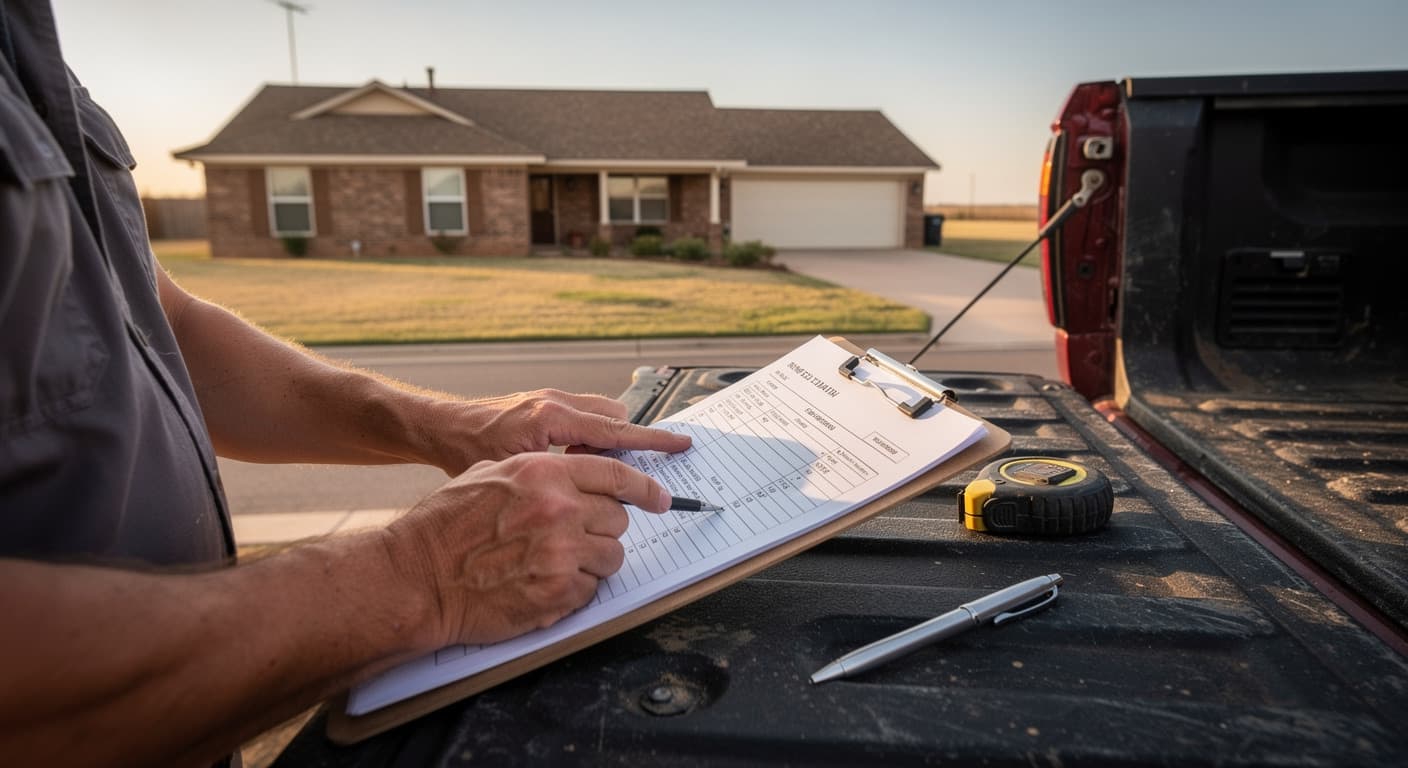
For a ballpark first, our free instant estimate gives you a range in under a minute. To compare written quotes:
- Ask for the load calculation in writing, including the charger at its full setting.
- Confirm the breaker size, wire size, and the charger's current setting all match.
- Ask whether it is hardwired or plug-in, and how GFCI protection is handled.
- Get the route in writing: surface conduit, attic, walls, or trench, and who patches.
- Confirm the quote includes the City of Lubbock permit and inspection.
- Check that an outdoor charger is outdoor rated and mounted clear of the driveway.
- Verify the TDLR license, and see our guide to choosing a reliable contractor.
A Note from Nextgen Blueprint
This guide was researched and published by Nextgen Blueprint, a Lubbock design-build contractor whose electrical services include EV charger circuits, load calculations, and panel upgrades. Treat these figures as September 2026 budgeting ranges for the Lubbock market, not a quote. Your price depends on where the panel sits, how far the charger goes, what the load calculation shows, and the charger you choose. Get a written, itemized estimate from a licensed electrical contractor before you commit.
Frequently asked questions
How much does it cost to install an EV charger in Lubbock, TX?
Do I need a panel upgrade to install a Level 2 charger?
Is a Level 1 charger enough?
Should an EV charger be hardwired or plugged in?
Do I need a permit for an EV charger in Lubbock?
Can I still get the federal tax credit for a home EV charger?
Can an EV charger be installed outside in Lubbock's wind and dust?
Sources and further reading
- [1]IRS: Alternative Fuel Vehicle Refueling Property Credit
- [2]U.S. DOE Alternative Fuels Data Center: Charging Electric Vehicles at Home
- [3]U.S. DOE Alternative Fuels Data Center: Electric Vehicle Charging Stations
- [4]U.S. DOE Alternative Fuels Data Center: Texas Electricity Laws and Incentives
- [5]City of Lubbock: Building Safety
- [6]TDLR: Exemptions to Electrician Licensing
- [7]EC&M: NEC Requirements for EV Equipment
- [8]Leviton Captain Code 2020: GFCI Protection for Receptacle Outlets Used for EV Charging
- [9]ChargePoint: Home Flex Installation FAQ
- [10]National Weather Service Lubbock: Historic Wind and Blowing Dust, March 14, 2025
- [11]Qmerit: Level 2 EV Charger Installation Costs
- [12]Fixr: Home Electric Vehicle Charging Station Cost
Written by
John Paul, Founder, Nextgen Blueprint
John Paul founded Nextgen Blueprint with his father-in-law, a Lubbock-area general contractor with 30+ years of experience. They build healthy, natural homes for Lubbock families, and approach every project with the kind of care and attention to detail most contractors save for their own home.
More from JohnRelated services
Filed under Cost Guides. What home projects actually cost in Lubbock, line by line.