Cost Guides12 min read
Electrical Panel Upgrade Cost in Lubbock, TX: 100 to 200 Amp and EV Chargers (2026)
What an electrical panel upgrade costs in Lubbock in 2026: 100 to 200 amp service, EV charger circuits, surge protection, smart panels, problem panels, LP&L, and permits.
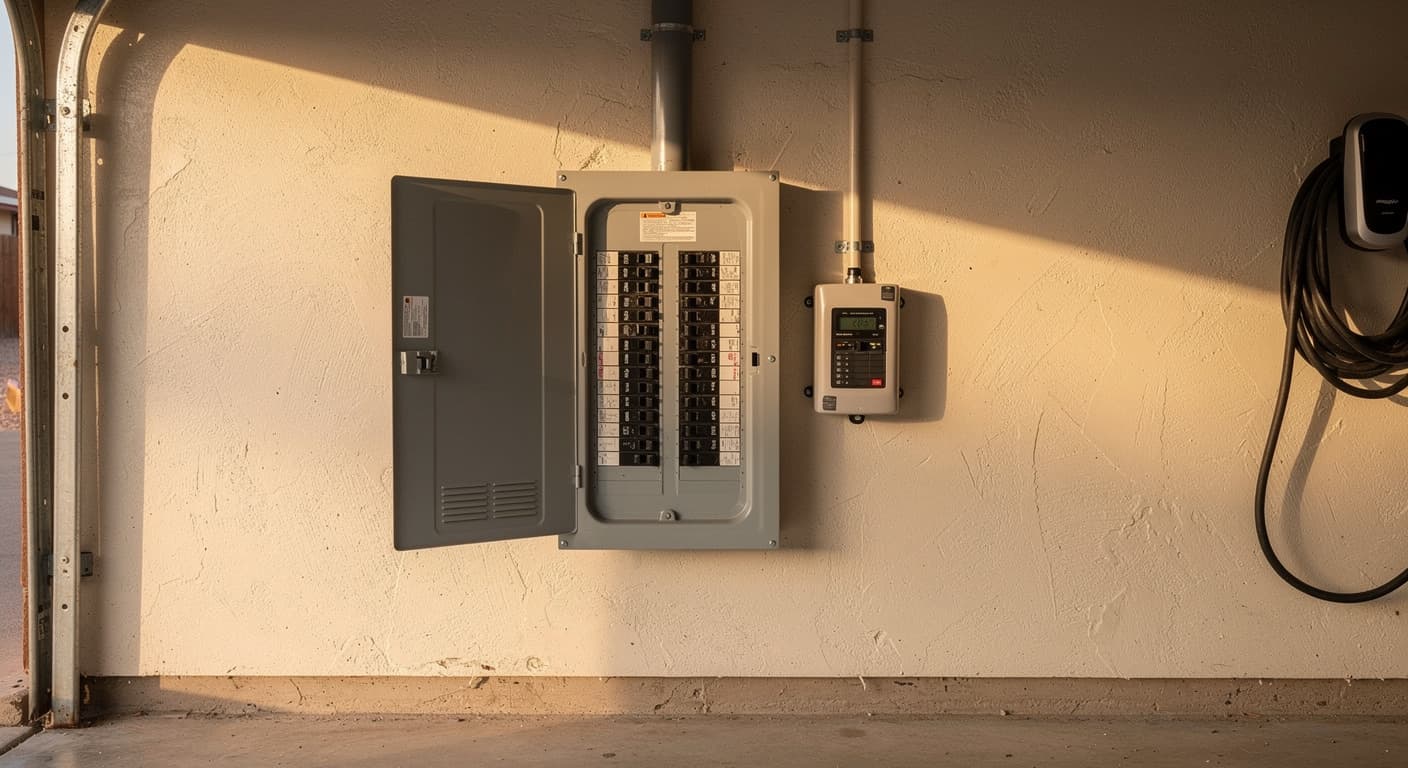
A full 100 to 200 amp service upgrade in Lubbock typically costs $2,000 to $5,000 in 2026, covering the panel, meter base, service entrance conductors, mast, grounding, permit, and the LP&L disconnect and reconnect. A same-size panel replacement runs $1,200 to $3,000, a Level 2 EV charger circuit $800 to $2,500, and a smart panel $5,000 to $10,000. The panel itself rarely moves the number. Everything around it does: the condition of the mast, the surge protection and disconnect rules in the 2020 code Lubbock enforces, the distance to the meter, and whether an older house hides a problem panel or aluminum wiring.
On this page
- 01What an Electrical Panel Upgrade Costs in Lubbock (2026)
- 02Where the Money Goes on a Panel or Service Upgrade
- 03Problem Panels and Wiring in Older Lubbock Homes
- 04Warning Signs Your Panel Needs Attention
- 05Load Calculations: Do You Actually Need 200 Amps?
- 06The Lubbock Factor: LP&L, Local Code, and a Long Cooling Season
- 07EV Chargers, Surge Protection, and Smart Panels
- 08Permits, Licensing, and Timeline in Lubbock
- 09How to Get an Accurate Quote
- 10A Note from Nextgen Blueprint
- 11Frequently asked questions
What an Electrical Panel Upgrade Costs in Lubbock (2026)
Price tracks scope: a panel swap replaces the breaker box and breakers, while a service upgrade also replaces the meter base, service entrance conductors, mast, and grounding so the house can actually draw 200 amps. National guides quote anywhere from about $750 to $4,500 for a 100 to 200 amp job, largely because some price the panel alone. Lubbock labor runs below Dallas, Austin, and Houston, while the city's code amendments add a few items older homes rarely have.
- Typical 100 to 200 amp upgrade
- $2,000 to $5,000
- Same-size panel replacement
- $1,200 to $3,000
- Level 2 EV charger circuit
- $800 to $2,500
| Project | Installed cost (typical home) | What it covers |
|---|---|---|
| Same-size panel replacement | $1,200 to $3,000 | New panel and breakers at the same amperage |
| 100 to 200 amp service upgrade | $2,000 to $5,000 | Panel, meter base, conductors, mast, grounding, permit |
| Subpanel | $500 to $1,750 | Small panel and feeder for a garage, shop, or addition |
| Level 2 EV charger circuit | $800 to $2,500 | 240-volt, 40 to 60 amp circuit; charger extra |
| Whole-home surge protector | $200 to $700 | Type 1 or Type 2 device at the panel, less during a panel job |
| Smart panel | $5,000 to $10,000 | Per-circuit monitoring and control in place of the main panel |
Where the Money Goes on a Panel or Service Upgrade
Quotes for the same house can differ by thousands of dollars because they price different jobs. A real 200 amp upgrade includes:
- Service equipment: the meter base, service entrance conductors, weatherhead, and mast, since conductors sized for 100 amps cannot carry 200. A 200 amp meter base alone runs about $85 to $680.
- Panel and breakers: the box is a few hundred dollars, and AFCI or GFCI breakers run roughly $35 to $100 each where code requires them.
- Grounding and bonding: typically $100 to $700 when the existing grounding is missing or faulty.
- Code items: a surge-protective device on any replaced service, and sometimes an outdoor disconnect.
- Labor, permit, and inspection, plus $1,000 to $4,000 if the panel moves.
Problem Panels and Wiring in Older Lubbock Homes
Age alone is not a reason to replace a panel, but a few brands are. Federal Pacific Electric Stab-Lok panels, common from the 1950s through about 1980, lead the list. After the company's owner reported to the Consumer Product Safety Commission in 1980 that many of its breakers did not fully meet UL requirements, CPSC testing confirmed failures on certain calibration tests. The CPSC closed its investigation in 1983 without a recall, citing limited data, and a New Jersey court later found the company sold breakers not tested to the UL standards on their labels. The concern is a breaker that may not trip on an overload.
Zinsco panels, also sold under the Sylvania name, were common through the 1970s. Their breakers can lose contact with the bus bar, arc, and melt in place so they cannot trip. Inspectors flag both brands, and replacement is usually a same-size swap.
For aluminum branch wiring, the CPSC says it is unlikely before 1965 but may appear in cable installed from 1965 to the mid 1970s, and a CPSC-sponsored survey found aluminum-wired homes built before 1972 were 55 times more likely than copper-wired homes to have an outlet connection reach fire hazard conditions. CPSC-recognized permanent repairs are copper rewiring, COPALUM crimp pigtails, and AlumiConn connectors. Pigtailing a typical house often runs a few thousand dollars, versus $8,000 to $25,000 for a full rewire.
In Tech Terrace, where many houses date from the early to mid 1900s, and the older homes around Overton, it is common to find panels added onto for decades, ungrounded two-prong circuits, and undersized services. Newer south and southwest Lubbock homes usually have 200 amps already.
Warning Signs Your Panel Needs Attention
Some call for a same-week visit, others for a plan before you add a big load:
- A warm panel cover, buzzing, a burning smell, or scorch marks. Call now.
- Breakers that trip repeatedly, or lights that dim hard when the air conditioner starts.
- Rust or water inside the panel, often from a leaking mast or meter base.
- A fuse box, a 60 or 100 amp service, or a panel packed with doubled-up breakers.
- A Federal Pacific or Zinsco label, or aluminum branch wiring.
- A big new load: an EV charger, heat pump, induction range, hot tub, shop, or home addition.
Load Calculations: Do You Actually Need 200 Amps?
A good electrician answers this with math. Article 220 of the National Electrical Code builds a home's load from general lighting at 3 volt-amperes per square foot, the kitchen and laundry circuits, fixed appliances, the larger of the heating or cooling load, and demand factors, since everything does not run at once. For existing homes, the code also allows using a year of actual peak demand data, which often shows more spare capacity.
A charger delivering 40 amps is about 9.6 kilowatts of continuous load while it runs. A 10 kilowatt heat strip in a heat pump air handler draws roughly 42 amps. A 100 amp house with an electric range, dryer, and central air rarely has room for either. A 200 amp house often does, and a load management device that slows charging while the house is busy can avoid an upgrade. Our heat pump installation cost guide covers heat strip sizing and dual fuel.
The Lubbock Factor: LP&L, Local Code, and a Long Cooling Season
LP&L's role changed recently, and it matters on the day of a panel swap. After LP&L finished moving customers onto the ERCOT grid in December 2023, customers chose retail electric providers between January 5 and February 15, 2024, or were assigned a default, and retail service began that March. But LP&L is still the wires company for the poles, lines, and meters inside city limits, and its tariff allows only LP&L-authorized personnel to connect or disconnect service. Your electrician arranges a clearance with LP&L at least three business days ahead, and since city code bars a utility from restoring service after an alteration until the building official authorizes it, the reconnect waits on the inspection.
The City of Lubbock enforces the 2020 National Electrical Code with local amendments, last updated in March 2024. Overhead service drops attach at the rear, alley side unless the city and utility agree otherwise. Masts must be rigid or intermediate metal conduit at least 2 inches in trade size, sensible given Lubbock's 60 to 100 mph wind events. Meters go outside, centered 5 to 6 feet above the ground.
A supplemental ground rod is required with a concrete-encased electrode or metal water pipe. New dwelling panels need room for two more circuits plus a spare 3/4-inch conduit to the attic or crawl space, branch circuits cannot use aluminum wire, and 12 AWG copper is the general minimum. Older houses often need more of this work, which pushes an upgrade toward the top of the range.
National Weather Service normals put Lubbock's average highs at 91.6 degrees in June, 93.4 in July, and 92.2 in August, so air conditioning is the biggest load most houses carry all summer. Older homes have often added central air and bigger condensers since the service was sized, and swapping a gas furnace for a heat pump adds electric backup heat on top.
- Lubbock electrical code
- 2020 NEC, amended
- LP&L clearance request
- 3 business days ahead
- Average July high
- 93.4°F
EV Chargers, Surge Protection, and Smart Panels
A Level 2 charger needs a dedicated 240-volt circuit sized at 125 percent of its output: 40 amps on a 50 amp circuit, or 48 amps on a hardwired 60 amp circuit. The 2020 code requires GFCI protection for 240-volt garage receptacles, which means a pricier breaker, so hardwiring is often the cleaner install. Long copper runs to a detached garage or shop push a job toward $2,500, and the charger itself adds $300 to $900. Our EV charger installation cost guide covers that job in detail. The federal 30C charger credit ended for equipment placed in service after June 30, 2026, and the 25C credit that covered some panel upgrades ended with 2025.
Surge protection is required whenever dwelling service equipment is replaced, and it costs least when added during the panel job. The same code calls for an outdoor emergency disconnect on one- and two-family homes, which on an upgrade can mean a meter-main combination if your only disconnect is an indoor panel. Smart panels add per-circuit monitoring and remote control that help manage solar, a battery, or an EV. At $5,000 to $10,000, they make the most sense when the panel is being replaced anyway. An energy monitor or a few smart breakers cost far less if you mainly want visibility, and our smart home team can help you choose. For backup power, our generator installation cost guide covers transfer switches and interlock kits.
Permits, Licensing, and Timeline in Lubbock
Inside city limits, a permit is required for nearly all electrical work beyond minor repairs like replacing a switch, receptacle, or fixture on existing wiring, and a general electrical permit goes only to a licensed electrical contractor. Owner-occupants of single-family homes can get a homeowner's permit after showing working knowledge of the code, though service work is a poor first project. Jobs get rough-in and final inspections, which city code calls for within 24 working hours of a request. Texas requires anyone doing non-exempt electrical work to be licensed through TDLR and to work through a licensed electrical contractor. Outside city limits, permit rules and the serving utility can differ.
Plan on one to three weeks from signed quote to finished work: several days for the permit and LP&L clearance, then one long day of work, 4 to 10 hours with the power off, followed by inspection and reconnect. Utility equipment changes or an underground feed add time. Schedule the outage for a mild day if you can.
How to Get an Accurate Quote
For a ballpark first, our free instant estimate returns a range in under a minute. To compare real quotes:
- Ask whether it is a panel swap or a full service upgrade, with the meter base, conductors, mast, and grounding listed.
- Get the load calculation in writing, including any planned EV charger, heat pump, or shop.
- Confirm who pulls the permit, books the LP&L clearance, and meets the inspector.
- Check that surge protection, any outdoor disconnect, and AFCI or GFCI breakers are included.
- Get change-order pricing for surprises like aluminum wiring or a corroded mast.
- Verify the TDLR license, and read our guide to choosing a reliable contractor.
A Note from Nextgen Blueprint
This guide was researched and published by Nextgen Blueprint, a Lubbock design-build contractor whose electrical team handles panel and service upgrades, EV charger circuits, and remodel rewiring. Treat these numbers as 2026 Lubbock-market ranges to budget with, not a quote, since the real figure depends on your service, the mast and meter base, the load calculation, and what turns up behind the panel cover. The pricing, code, and LP&L details were accurate as of September 2026. Get a written, itemized estimate from a licensed local electrical contractor before you commit.
Frequently asked questions
How much does an electrical panel upgrade cost in Lubbock, TX?
How much does it cost to upgrade from 100 to 200 amp service?
Do I need a panel upgrade to install an EV charger?
How much does it cost to install a Level 2 EV charger in Lubbock?
Should I replace a Federal Pacific or Zinsco panel?
Do I need a permit to replace an electrical panel in Lubbock?
How long does a panel upgrade take, and how long is the power off?
Who shuts off the power for a panel upgrade now that Lubbock has retail choice?
Sources and further reading
Written by
John Paul, Founder, Nextgen Blueprint
John Paul founded Nextgen Blueprint with his father-in-law, a Lubbock-area general contractor with 30+ years of experience. They build healthy, natural homes for Lubbock families, and approach every project with the kind of care and attention to detail most contractors save for their own home.
More from JohnRelated services
Filed under Cost Guides. What home projects actually cost in Lubbock, line by line.