Cost Guides14 min read
Water Heater Replacement Cost in Lubbock, TX: Tank vs Tankless and Hard Water (2026)
What water heater replacement costs in Lubbock in 2026: 40 to 50 gallon gas and electric tanks, tankless units, gas line and venting upgrades, code items, hard water, sizing, and permits.
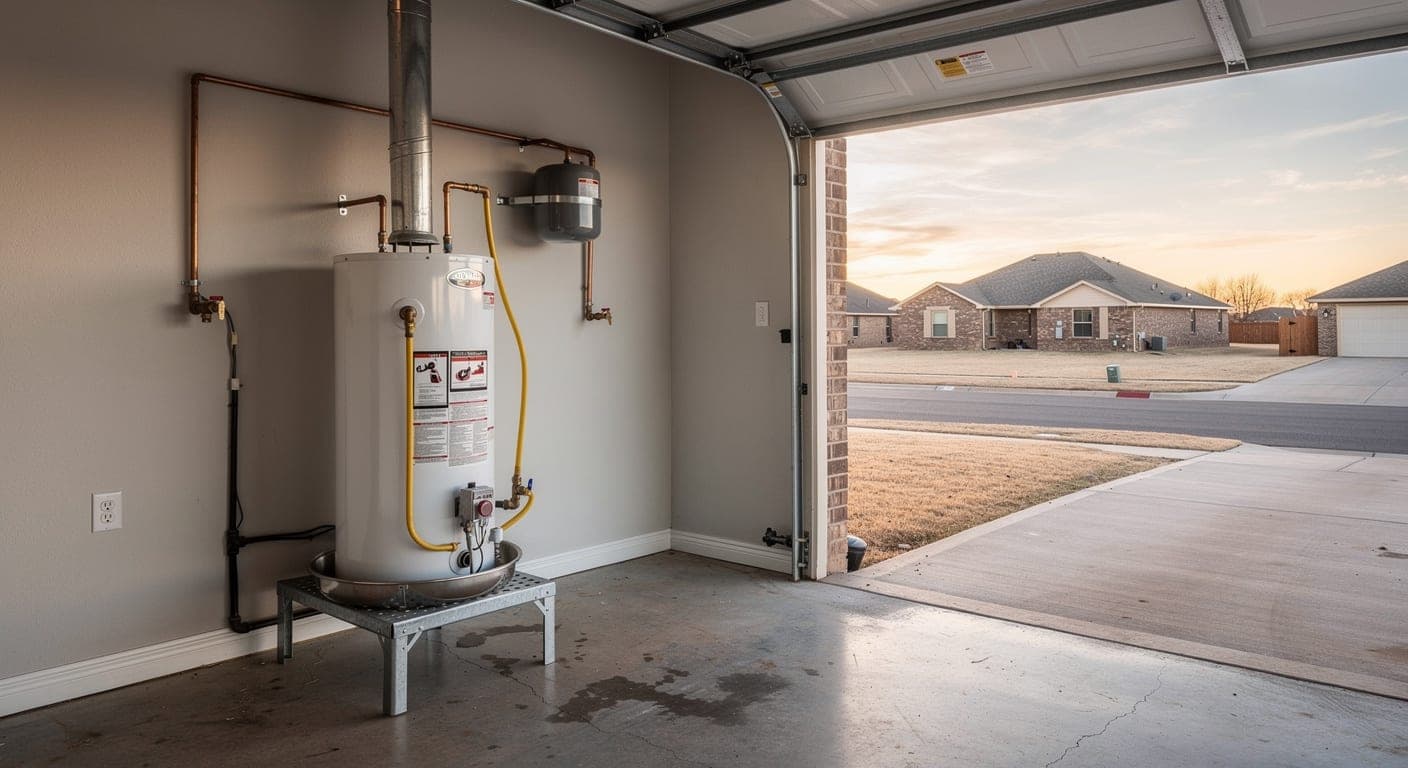
Replacing a 40 to 50 gallon tank water heater in Lubbock typically costs $1,100 to $2,500 installed in 2026, and a tankless water heater runs $2,000 to $5,000. Electric tanks land at the low end, gas tanks in the middle, and tankless conversions climb with the gas line, venting, and electrical work they need. Lubbock's hard water shapes the decision more than most national guides admit: the City's 2025 water report averaged 169 ppm of hardness, about 10 grains per gallon, with samples up to 244 ppm, which is above the 200 mg/L limit in at least one major tankless maker's water quality guidelines. Here is what drives the price, how to size a unit, and when repair still makes sense.
On this page
- 01What Water Heater Replacement Costs in Lubbock (2026)
- 02Where the Money Goes on a Water Heater Replacement
- 03Tank vs Tankless: Cost, Lifespan, and Payback
- 04The Lubbock Factor: Hard Water Shortens Tanks and Scales Tankless Units
- 05What Makes a Tankless Conversion Cost More
- 06Sizing for Cold Incoming Water and Real Household Demand
- 07Repair or Replace Your Water Heater?
- 08A Worked Example: A 1980s Lubbock Ranch With a Failing Gas Tank
- 09Permits, Licensing, and Code in Lubbock
- 10Heat Pump Water Heaters in Lubbock
- 11How to Get an Accurate Water Heater Quote
- 12A Note from Nextgen Blueprint
- 13Frequently asked questions
What Water Heater Replacement Costs in Lubbock (2026)
Most quotes you will see fall into one of the rows below. The price covers the heater, removal of the old unit, labor, the permit, and the code items a replacement has to meet, such as the relief valve discharge line and, where required, a drain pan and thermal expansion control. National cost sites quote lower numbers for a 40 gallon tank, often because they leave out the permit and the code catch-up older installations need. Lubbock labor runs a little below the big Texas metros, while the equipment costs about the same everywhere.
- Typical tank replacement
- $1,100 to $2,500
- Tankless water heater
- $2,000 to $5,000
- Lubbock hardness, 2025 average
- 169 ppm
| Project | Installed cost (Lubbock, 2026) | What it covers |
|---|---|---|
| Electric tank, 40 to 50 gallon | $1,100 to $2,000 | Like-for-like swap on an existing 240-volt circuit |
| Gas tank, 40 to 50 gallon | $1,300 to $2,500 | Atmospheric vent, reusing a sound flue and gas line |
| Typical tank replacement | $1,100 to $2,500 | Gas or electric, permit and haul-away included |
| Tankless water heater | $2,000 to $5,000 | Gas or electric, with gas line and venting upgrades as needed |
| Thermal expansion tank | $150 to $400 | Added where a check valve or pressure-reducing valve closes the system |
| Repair visit | $150 to $750 | Element, thermostat, thermocouple, or relief valve |
Where the Money Goes on a Water Heater Replacement
A straight swap in the same spot, with the same fuel and the same size, costs the least. Every change from the old setup adds labor and parts:
- The heater: a standard 40 gallon gas tank such as A. O. Smith's ProLine GCB-40 burns 40,000 Btu per hour, delivers 78 gallons in the first hour, and carries a 6-year tank and parts warranty. Longer warranties and higher efficiency cost more.
- Removal and disposal of the old tank, about $50 to $150 on its own.
- Code items: a relief valve discharge line that ends at an air gap, a drain pan where a leak would cause damage, and a thermal expansion tank on closed systems.
- Garage placement: a gas heater with an ignition source must sit with that source at least 18 inches above the garage floor unless it is listed as flammable vapor ignition-resistant.
- Access and moves: attic and closet installs take longer, and relocating the heater means new gas, water, and vent runs.
- The permit and inspection, which a licensed plumber pulls as part of the job.
Tank vs Tankless: Cost, Lifespan, and Payback
A tank heater stores 40 to 50 gallons and keeps it hot around the clock. A tankless unit fires only when a tap opens and heats water as it flows through a compact heat exchanger. Both work well when sized right. The differences are cost, capacity, life, and upkeep.
InterNACHI puts the typical tank water heater at about 10 years, and notes that heaters in areas with more minerals in the water have shorter lives. ENERGY STAR gives tankless units a 20-year life expectancy and estimates that a labeled gas tankless heater saves a family of four about $95 a year, or $1,800 over its life, compared with a standard gas tank.
That makes the payback math simple. If tankless costs $1,500 to $2,500 more than a gas tank in your house, $95 a year takes roughly 16 to 26 years to recover it, which is close to the unit's whole life. Choose tankless because you run out of hot water, want the floor space back, or plan to stay a long time, not to save money on gas.
| Factor | Gas or electric tank | Tankless |
|---|---|---|
| Installed cost in Lubbock | $1,100 to $2,500 | $2,000 to $5,000 |
| Typical life | About 10 years | About 20 years |
| Hot water supply | Limited by tank size and recovery | Continuous, limited by flow rate |
| Hard-water upkeep | Flush at least yearly, check the anode | Descale on schedule, treat the water |
| Gas demand at full fire | About 40,000 Btu for a 40 gallon tank | Up to 199,000 Btu for a large unit |
The Lubbock Factor: Hard Water Shortens Tanks and Scales Tankless Units
Lubbock's water is a blend. In 2025, 61 percent came from Ogallala Aquifer groundwater through the Roberts County and Bailey County well fields and 39 percent from Lake Alan Henry and Lake Meredith. The City's 2025 water quality report averaged 169 ppm of hardness, about 10 grains per gallon, with samples from 81 to 244 ppm, and 633 ppm of total dissolved solids, with samples from 321 to 991 ppm. The 2024 report averaged 192 ppm.
In a tank, those minerals settle as sediment on the bottom. A. O. Smith says most tank heaters need flushing at least once a year and more often on hard water, and recommends inspecting the anode rod, the sacrificial rod that protects the steel tank, once a year.
Tankless units are more sensitive. Rinnai's installation manual lists water quality guidelines of up to 200 mg/L of total hardness and up to 500 mg/L of dissolved solids, says water in hard-water areas must be treated and may need more frequent flushing, and states that heat exchanger damage from water quality or lime buildup is not covered by the warranty. Lubbock's average dissolved solids already sit above that 500 mg/L line, and its hardest samples top the 200 mg/L one.
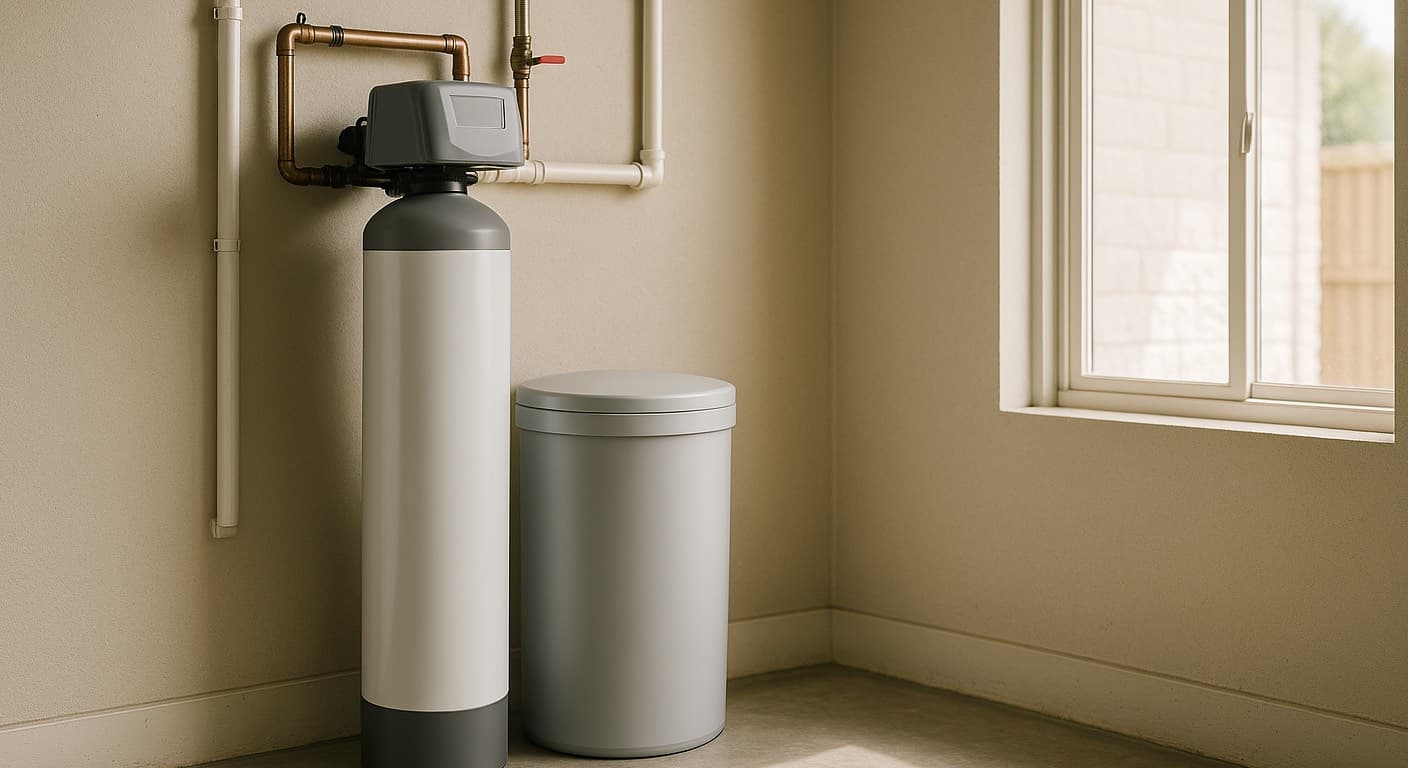
That is why tankless in Lubbock should come with isolation valves for flushing and, for most homes, a water softener. Our water softener cost guide covers sizing and the $1,200 to $3,800 installed price.
- 2025 hardness, average
- 169 ppm (about 10 gpg)
- 2025 hardness, highest sample
- 244 ppm
- Rinnai hardness guideline
- Up to 200 mg/L
What Makes a Tankless Conversion Cost More
The gas line is the big one. A 40 gallon tank burns about 40,000 Btu per hour, while large tankless units such as Rinnai's RU199 models burn up to 199,000. In the sizing worksheet from Rinnai's own manual, a 199,000 Btu heater plus 65,000 Btu of other gas appliances needs 264 cubic feet of gas per hour. The manual's reference table shows 3/4-inch pipe carrying 360 cubic feet per hour at 10 feet but only 247 at 20 feet, so a longer run steps up to 1-inch pipe. If the existing branch to your water heater is 1/2-inch, the same table rates it at 118 cubic feet per hour at 20 feet, well short of the 199 a large unit alone can draw.
Venting changes too. An atmospheric tank vents through a 4-inch metal B-vent flue, while a condensing tankless unit uses 2-inch PVC or polypropylene and needs a condensate drain and a 120-volt outlet. Outdoor units skip the vent but need freeze protection.
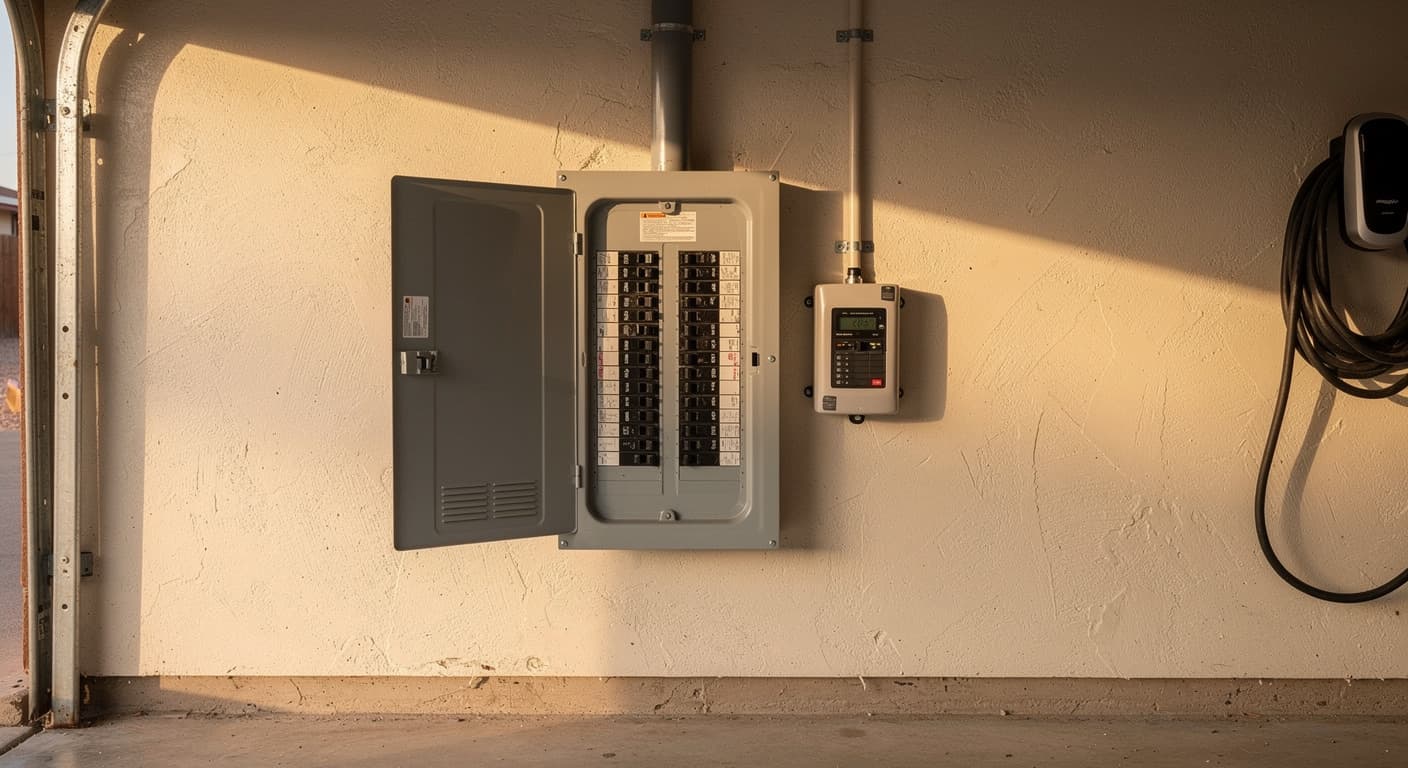
Electric tankless is a different trade-off. A whole-house electric unit draws far more current than an electric tank, often on multiple dedicated 240-volt circuits, so check panel capacity first. Our electrical panel upgrade cost guide covers load calculations and what a service upgrade costs.
Sizing for Cold Incoming Water and Real Household Demand
Tanks are sized by first-hour rating, the gallons of hot water a full tank delivers in its first hour. The 40 gallon gas tank above is rated at 78 gallons, and it recovers about 42 gallons an hour after that. A family that runs two showers and the washer back to back in the morning may need a 50 gallon tank or a higher-input model.
Tankless units are sized by flow rate and temperature rise. Navien's sizing guide defines temperature rise as the setpoint minus the incoming water temperature, and says to calculate it for the coldest days of the year, since incoming water cools in winter. Water set to 120°F with 55°F water coming in needs a 65 degree rise. Navien's rough guide is 3.5 gallons per minute for one or two fixtures at once, 5 for two or three, and 7 for three or four, with showers and dishwashers at 2 to 3 gallons per minute each and washing machines at 3 to 5.
An undersized unit shows up first in January, as lukewarm showers when a second tap opens. Ask the installer which inlet temperature they sized for.
Repair or Replace Your Water Heater?
National repair data puts most water heater repairs at $150 to $750, with an average near $450. Heating elements run about $200 to $750 to replace, thermostats $100 to $250, anode rods $125 to $300, thermocouples $150 to $325, and relief valves $100 to $250. The same data suggests replacing when a repair quote reaches $1,000 or more.
Use these rules of thumb:
- Repair a young heater with a failed part: an element, thermostat, thermocouple, or relief valve on a unit still well inside its warranty.
- Replace a tank that leaks from the tank itself. Water pooling under the heater from the tank body cannot be fixed.
- Replace a tank near or past 10 years that needs a significant repair, especially on untreated Lubbock water.
- Consider replacing a tank that rumbles and runs short on hot water after flushing, since heavy sediment often means a tired tank.
- Plan the replacement before it fails if the heater sits in an attic or closet, where a leak does the most damage. Our Lubbock home maintenance calendar schedules the yearly flush and anode check.
A Worked Example: A 1980s Lubbock Ranch With a Failing Gas Tank
Take a 1,900 square foot brick ranch from the mid 1980s in southwest Lubbock, with its original gas water heater replaced once, now 12 years old and seeping at the base. It sits in the garage on a stand, on untreated city water.
Option one is a like-for-like 50 gallon gas tank in the same spot, reusing the gas line and the 4-inch flue. With a new relief valve discharge line, a pan, an expansion tank if the house has a pressure-reducing valve, haul-away, and the permit, expect about $1,600 to $2,200, inside the $1,300 to $2,500 gas tank range. It is done in half a day.
Option two is a 199,000 Btu condensing tankless unit on the garage wall. The gas branch is 1/2-inch and about 25 feet from the meter, so it gets a larger line, plus new PVC venting, a condensate drain, an outlet, and isolation valves. That lands near the upper half of the $2,000 to $5,000 tankless range, roughly $3,800 to $5,000, and takes about a day. Add a softener if the house does not have one.
The difference, roughly $1,600 to $3,400, buys continuous hot water and a unit with about twice the life expectancy. At ENERGY STAR's $95 a year, gas savings alone would not repay it.
Permits, Licensing, and Code in Lubbock
The City of Lubbock issues water heater permits as generic permits, available through its Citizen Self Service portal or at Building Safety, and the installation is inspected. The city enforces the 2021 International Residential Code, 2021 International Plumbing Code, and 2021 International Fuel Gas Code as of September 2026. The fee is on the city's form and fee schedule, and your plumber normally builds it into the quote.
Under the Texas Plumbing License Law, a property owner does not need a plumbing license to do plumbing in their own homestead, and the city will issue plumbing permits to homeowners who own and live in the house when they or an immediate family member do the work. The law exempts appliance dealers who connect appliances to existing openings, but it specifically excludes water heaters from that exemption, so a store's installer who is not a licensed plumber should not be setting yours.
The code items inspectors look for include the relief valve discharge, which cannot connect directly to the drain system and must end at an air gap in the same room; a pan at least 1 1/2 inches deep with a 3/4-inch drain where a pan is required; the 18-inch ignition source rule in garages; and thermal expansion control where a check valve, backflow preventer, or pressure-reducing valve closes the system. Outside city limits, confirm the rules with the county or town.
Heat Pump Water Heaters in Lubbock
A heat pump water heater moves heat from the surrounding air into the tank instead of making all of it with an electric element, which makes it the efficiency upgrade to price for homes without gas. The catch is placement. ENERGY STAR says these units belong in interior spaces that stay between 40°F and 90°F year-round with about 1,000 cubic feet of air around them, and that with colder incoming water they may switch temporarily to standard electric backup in winter. They also need annual maintenance, including air filter changes.
Many Lubbock water heaters sit in garages, and with an average July high of 93.4°F outside, a garage can easily run past 90°F in summer and cool well below that on winter nights, so a heat pump model fits best in a conditioned utility room or a large interior closet with enough air. Price one as a separate quote, since installation varies more than a tank swap.
How to Get an Accurate Water Heater Quote
For a ballpark first, our free instant estimate returns a range in under a minute. To compare real quotes:
- Ask whether the quote is a like-for-like swap or includes gas line, venting, electrical, or relocation work, with each item listed.
- Get the size and the basis: first-hour rating for a tank, or flow rate and the winter inlet temperature used for tankless.
- Confirm the permit, the relief valve discharge line, the pan, and thermal expansion control are included.
- For tankless, ask for isolation valves and a plan for your water: a softener, scale treatment, or a descaling schedule.
- Read the warranty's water quality and maintenance terms before you buy.
- Verify the plumber's Texas license, and read our guide to choosing a reliable contractor.
A Note from Nextgen Blueprint
This guide was researched and published by Nextgen Blueprint, a Lubbock design-build contractor whose plumbing team installs tank and tankless water heaters, softeners, and reverse osmosis systems through state-licensed plumbers. Treat these numbers as September 2026 Lubbock budgeting ranges, not a quote, since the real price depends on the fuel, the location, the gas line, the venting, and what the old installation left behind. Water quality, code, and permit details were checked as of September 2026. Get a written, itemized estimate from a licensed plumber before you commit.
Frequently asked questions
How much does it cost to replace a water heater in Lubbock, TX?
How much does a tankless water heater cost to install in Lubbock?
Is a tankless water heater worth it in Lubbock?
How long does a water heater last with Lubbock's hard water?
Do I need a permit to replace a water heater in Lubbock?
Does a water heater need an expansion tank?
Should I repair or replace my water heater?
How often should a tankless water heater be descaled in Lubbock?
Sources and further reading
- [1]City of Lubbock: 2025 Water Quality Report (Consumer Confidence Report)
- [2]City of Lubbock Building Safety: FAQs and Reports
- [3]Texas State Board of Plumbing Examiners: The Plumbing License Law, Occupations Code Chapter 1301
- [4]ENERGY STAR: Save More with ENERGY STAR Gas Tankless Water Heaters
- [5]ENERGY STAR: Heat Pump Water Heaters
- [6]UpCodes: 2021 International Residential Code, Chapter 28 Water Heaters (Texas)
- [7]Rinnai: N Series Residential Condensing Tankless Water Heater Installation and Operation Manual
- [8]A. O. Smith: Water Heater Maintenance Guide
- [9]A. O. Smith: ProLine 40-Gallon Atmospheric Vent Natural Gas Water Heater (GCB-40)
- [10]Navien: Tankless Water Heater Sizing Guide
- [11]InterNACHI: Estimating the Lifespan of a Water Heater
- [12]Fixr: Water Heater Repair Cost
Written by
John Paul, Founder, Nextgen Blueprint
John Paul founded Nextgen Blueprint with his father-in-law, a Lubbock-area general contractor with 30+ years of experience. They build healthy, natural homes for Lubbock families, and approach every project with the kind of care and attention to detail most contractors save for their own home.
More from JohnRelated services
Filed under Cost Guides. What home projects actually cost in Lubbock, line by line.