Homeowner Guides15 min read
Frozen Pipes in Lubbock, TX: How to Prevent Them and What to Do When One Bursts
How to prevent frozen pipes in Lubbock: where pipes freeze in South Plains homes, insulation and heat cable that work, how to shut off water at the City meter, what to do the moment a pipe bursts, and Texas insurance basics.
To prevent frozen pipes in Lubbock, insulate every supply line in the attic, garage, exterior walls, and crawl space before the average first freeze around October 31, keep the heat at 55 degrees or higher even when you are away, and on hard-freeze nights open sink cabinets and let a faucet drip. Know where your shutoff is, too: if a pipe bursts, closing the house valve or the City valve at the meter in the first few minutes is what keeps a $300 to $1,200 plumbing repair from becoming a flooded room. Lubbock does not freeze often, but when it does it can stay below freezing for days, as it did for almost four straight days in January 2026. Here is where pipes freeze in South Plains homes, what to do before and during a cold snap, how to handle a burst, and the permanent fixes worth paying for.
On this page
- 01Why Frozen Pipes Are a Real Risk in Lubbock
- 02Where Pipes Freeze in a Lubbock Home
- 03How to Prevent Frozen Pipes in Lubbock Before a Hard Freeze
- 04During the Freeze: Heat, Cabinets, and Dripping Faucets
- 05Pipe Insulation and Heat Cable: What Works and What It Costs
- 06Find Your Shutoff Before You Need It
- 07If a Pipe Freezes: How to Thaw It Safely
- 08If a Pipe Bursts: What to Do in the First Hour
- 09Insurance and Water Damage Cleanup in Texas
- 10Permanent Fixes: Rerouting, PEX, Frost-Free Bibs, and Smart Shutoff Valves
- 11Frozen Pipe Mistakes to Avoid
- 12A Note from Nextgen Blueprint
- 13Frequently asked questions
Why Frozen Pipes Are a Real Risk in Lubbock
Lubbock winters are mostly mild, which is exactly why pipes here get caught out. Many slab homes run supply lines through the attic and exterior walls, and owners who rarely see a hard freeze have little reason to insulate them. Then an Arctic outbreak arrives and stays.
NWS Lubbock puts the average first fall freeze on October 31 and the average last spring freeze on April 10, with a first freeze as early as October 7 on record. Duration is what bursts pipes. In January 2026, the airport hit minus 2 degrees, breaking the daily record of 7 degrees set in 1966, and stayed at or below freezing for 95 hours and 35 minutes. In February 2021, the city spent seven straight days at or below freezing, and the record is eight days, ending December 25, 1983.
- Average first freeze
- October 31
- January 2026 low
- Minus 2 degrees
- January 2026 hours below freezing
- 95 hours, 35 minutes
Where Pipes Freeze in a Lubbock Home
Pipes freeze where cold air reaches them and house heat does not. The Red Cross points to pipes against exterior walls and where the water service enters the home. In Lubbock, that list is longer, because so many slab homes run supply lines overhead. Check each of these spots before winter.
| Location | Why it freezes | The usual fix |
|---|---|---|
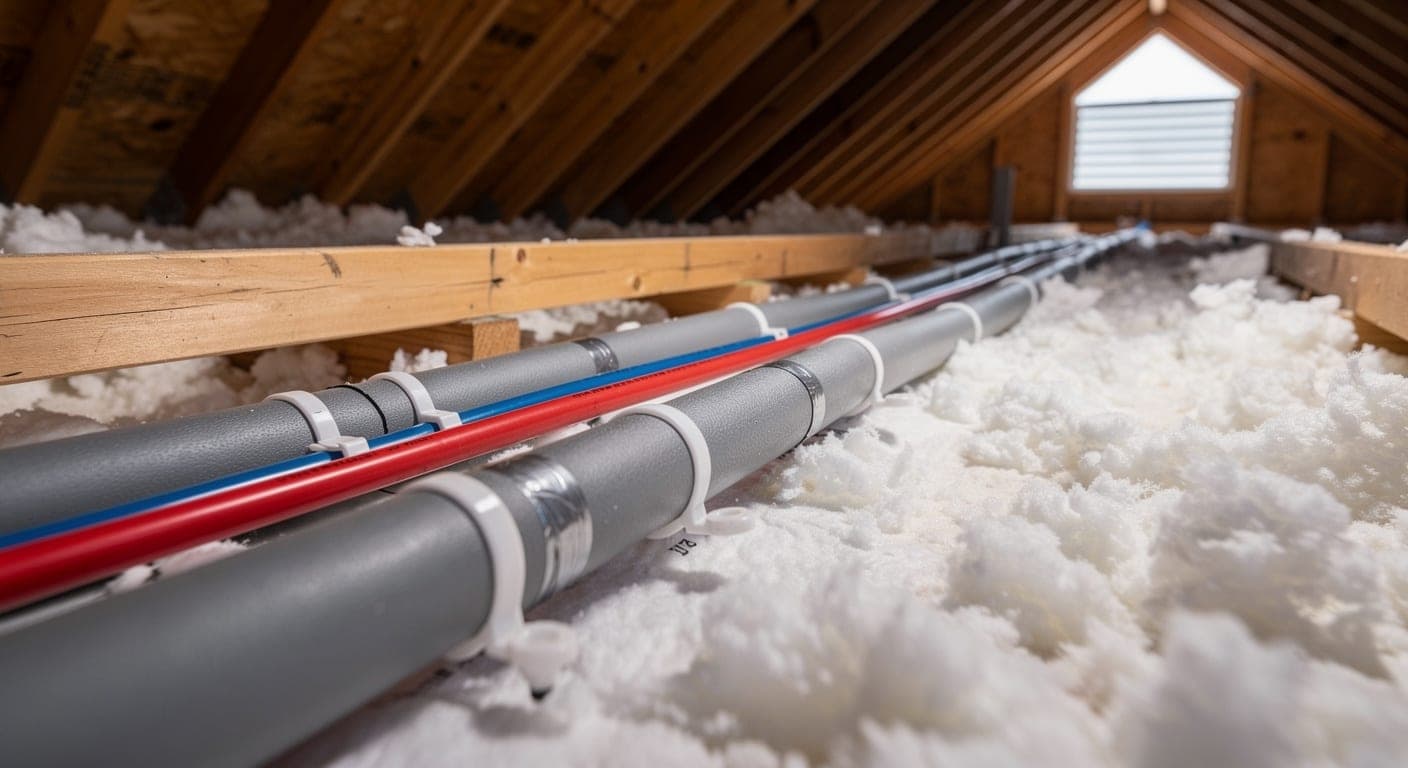
| Attic supply lines | Lines laid on or above the ceiling insulation sit in outdoor-temperature air | Bury lines under the insulation on the warm side, or insulate the pipe itself |
| Exterior walls | Lines behind brick with little insulation between pipe and outside | Open cabinets in a freeze, add insulation, or reroute |
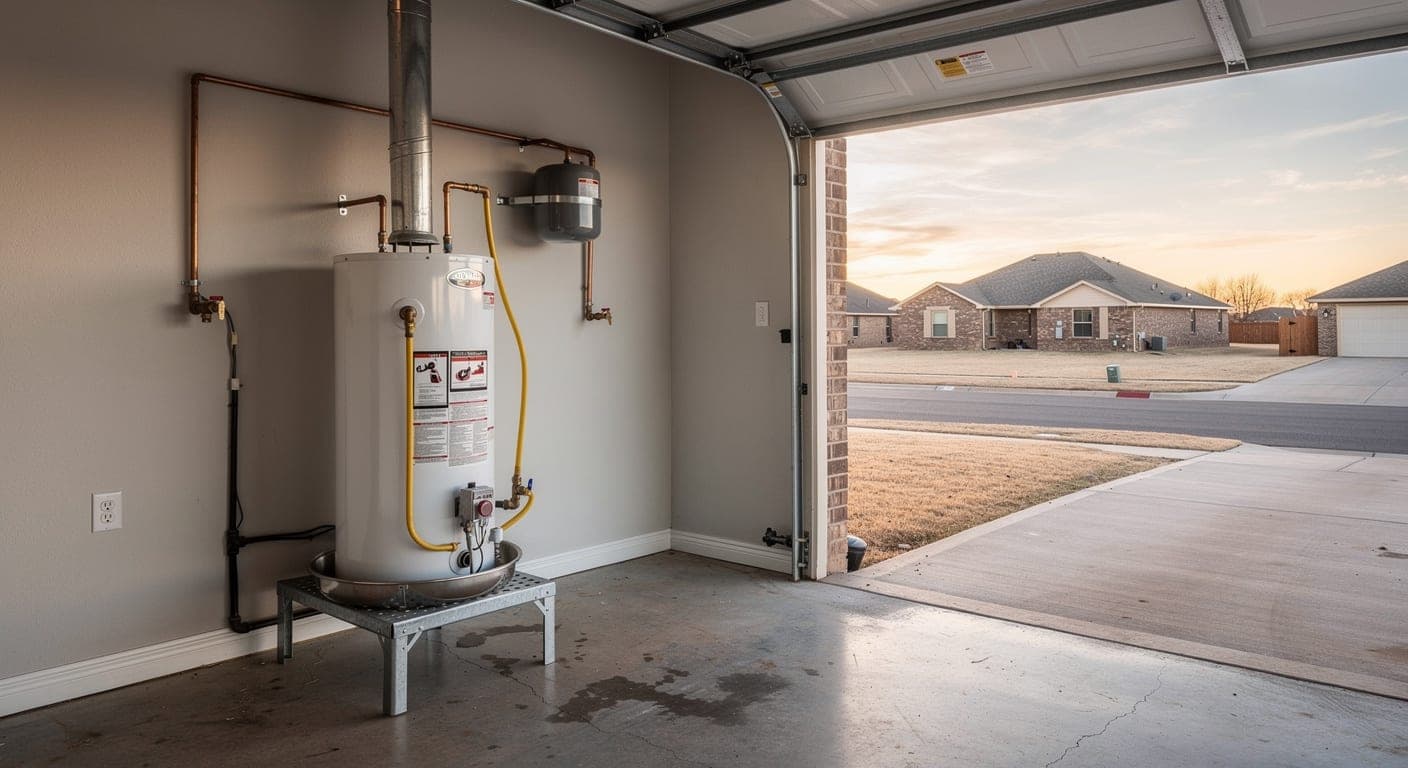
| Garage | Washer boxes, softener loops, and water heater lines in unheated space | Pipe insulation, closed garage door, washer valves off |
| Crawl space (pier and beam) | Wind through foundation vents chills lines under the floor | Insulate pipes and cover the vents for the cold snap |
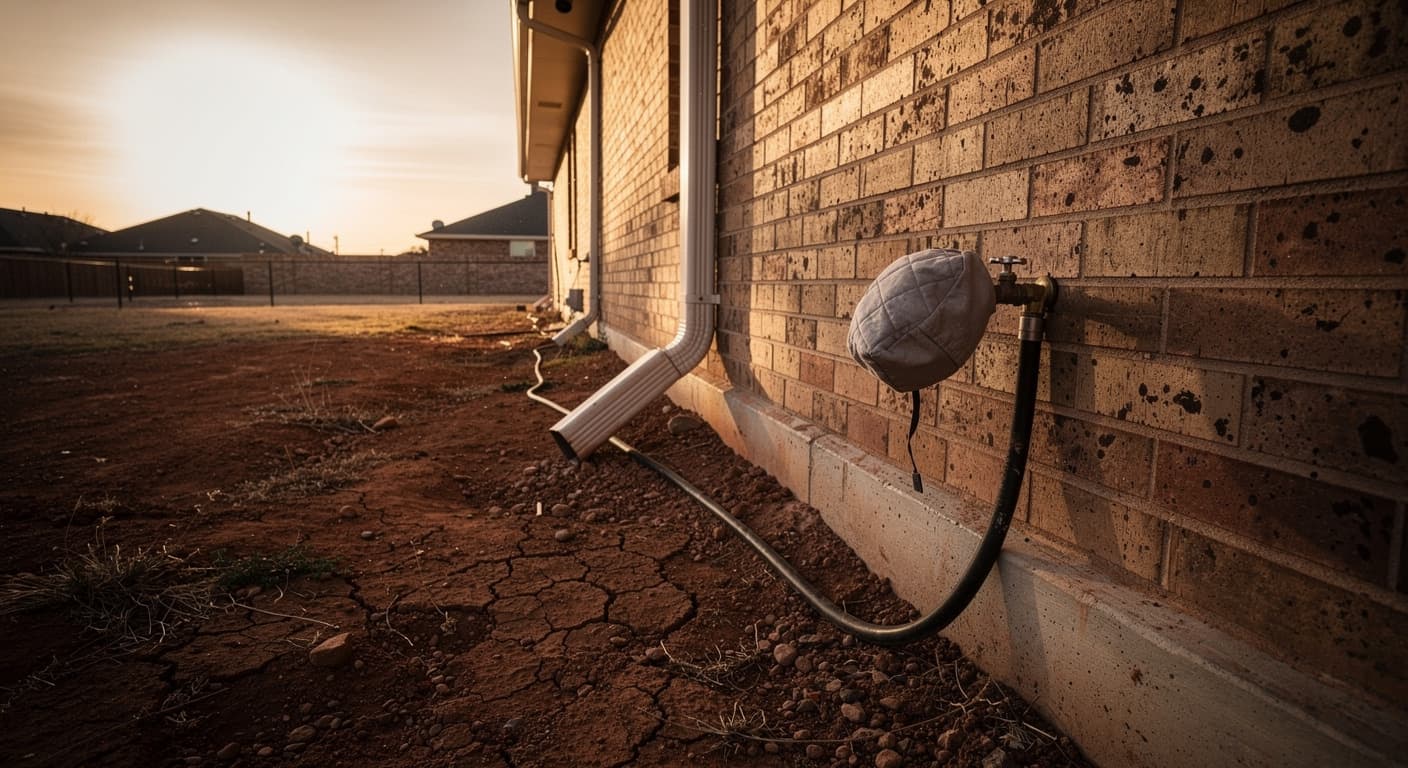
| Hose bibs | A connected hose traps water in the valve body | Disconnect hoses, add covers, or install frost-free bibs |
| Sprinkler backflow preventer | Brass assembly sits above ground in the wind | Shut off, drain, insulate, and cover it |
| Water service at the meter | Shallow line where it enters the house | Insulate exposed sections; call the City about a frozen meter |
How to Prevent Frozen Pipes in Lubbock Before a Hard Freeze
Most of this is fall work, done once. Texas A&M AgriLife suggests preparing in October or November and leaving protections in place through March or April, and notes that pipe wrap and heat tape often sell out once freeze warnings go out. Our Lubbock home maintenance calendar puts the seasonal tasks on a schedule; these are the pipe-specific ones.
- Walk the attic, garage, and any crawl space with a flashlight and list every exposed supply line.
- Insulate those lines with foam or fiberglass pipe insulation, and seal the joints with tape. IBHS calls out attics, crawl spaces, and exterior walls specifically.
- Disconnect, drain, and store every garden hose. If you do not have frost-free outdoor faucets, IBHS advises shutting off and insulating their valves.
- Shut off and drain the sprinkler system, as TDI recommends, then wrap the backflow preventer in insulation and a weatherproof cover.
- Turn off the water to a washer in an unheated garage, as TDI suggests.
- Seal gaps where pipes pass through exterior walls, and caulk and weatherstrip around nearby doors and windows.
- Find and test your main shutoff valve, and confirm you can open the meter box lid (see the shutoff section below).
During the Freeze: Heat, Cabinets, and Dripping Faucets
When a hard freeze is in the forecast, the goal is to keep warm air around the pipes and keep water moving. If an outage could cut your heat for long, our generator installation cost guide compares backup power options.
Keep the thermostat at the same setting day and night, and no lower than 55 degrees, the floor both the Red Cross and IBHS give, even if you leave town. Open kitchen and bathroom sink cabinets on exterior walls so house heat reaches the pipes, and keep the garage door closed if water lines run through the garage.
On the coldest nights, let a faucet served by exposed pipes drip. The Red Cross says running water through a pipe, even at a trickle, helps keep it from freezing, and TDI suggests dripping both the hot and cold taps. Pick the faucets farthest from where the water enters the house or nearest the trouble spots, and keep the drain clear so a slow drip cannot back up.
Pipe Insulation and Heat Cable: What Works and What It Costs
Insulation slows heat loss; it does not add heat. It buys hours, which is often enough for an overnight freeze in a heated house. For a pipe that sits in truly cold space for days, such as a crawl space line or an exposed run in an outbuilding, heat cable adds heat.
Treat heat cable as an electrical device, because it is one. In a 1990 safety alert, the Consumer Product Safety Commission tied heat tapes to about 3,300 home fires a year, many from bad installation. Its rules still apply: buy a cable sized for the pipe, wrap it directly on the pipe and never over insulation, do not overlap it unless the instructions allow it, and replace any cable with cracked covering, bare wire, or charring. Current self-regulating kits call for a ground-fault protected outlet and should never be hidden inside a wall.
| Prevention item | Typical Lubbock cost | Notes |
|---|---|---|
| Foam pipe insulation, DIY | Under $2 per foot of pipe | Fine for accessible attic, garage, and crawl space runs |
| Pipe insulation, plumber installed | $100 to $500 | Accessible runs; more when lines are buried in attic insulation |
| Heat cable, installed | $150 to $400 per run | Self-regulating cable on one pipe run; outlet work extra |
Find Your Shutoff Before You Need It
Every Lubbock household should know two valves. The first is the house-side main shutoff, usually in the garage near the water heater, at a softener loop, or on the line where it enters the house. Turn it fully closed and open once a year so it does not seize.
The second is the City's valve in the meter box. In a January 2026 thaw notice, the City of Lubbock said residential meter boxes sit either behind or in front of the house, under a round or rectangular lid you can lift with a large flathead screwdriver. The shutoff is a metal piece about 6 to 8 inches from the glass face of the meter. Turn it until the holes in its two tabs line up, and the water is off. If you cannot find the box or turn the valve, call City of Lubbock Water Dispatch at 806-775-2588.
If a Pipe Freezes: How to Thaw It Safely
No water, or just a trickle, from one faucet during a freeze usually means an ice plug upstream. Act before it splits the pipe.
- Find the likely spot: an exterior wall, the attic above that fixture, or the garage. Frost on a pipe or a bulge in it is a giveaway.
- If you see a crack or bulge, shut off the water first, because a split pipe leaks as soon as the ice melts. TDI advises turning off the water at the shutoff valve when pipes freeze.
- Open the faucet the pipe serves, so melting ice and water can move out.
- Apply gentle heat from the faucet side back toward the frozen section: a hair dryer, an electric heating pad, or towels soaked in hot water, as the Red Cross suggests.
- Never use a torch, a kerosene or propane heater, a charcoal stove, or any open flame.
- Keep heating until full water pressure returns, then check every faucet in the house for other frozen spots.
- If you cannot find the frozen section, cannot reach it, or cannot thaw it, call a licensed plumber.
If a Pipe Bursts: What to Do in the First Hour
Speed decides the size of the bill. Work through these steps in order.
- Shut off the water at the house main, or at the City valve in the meter box if you cannot find or close the house valve.
- If water is near outlets, light fixtures, or the panel, shut off power to those circuits at the breaker, and stay out from under a sagging, wet ceiling.
- Open the lowest faucet in the house to drain the lines, and turn off the water heater if its supply is shut off.
- Photograph and video the damage before you clean up, then move furniture, rugs, and valuables off wet floors.
- Mop and vacuum standing water, run fans, and open cabinets and closet doors to start drying.
- Call a licensed plumber to repair the pipe, and your insurer to report the claim.
- If drywall, insulation, or flooring got soaked, call a water mitigation company the same day.
Insurance and Water Damage Cleanup in Texas
According to the Texas Department of Insurance, most Texas home and renters policies cover sudden and accidental water damage, such as a burst pipe, and your belongings are covered too. Two warnings matter here. TDI says a policy might not pay for frozen pipe damage if you did not take steps to protect the pipes, such as keeping the heat on. And policies generally exclude gradual leaks and seepage, including mold that results from them, so report damage promptly: TDI notes you usually must report water damage that was hidden from view within days after you first see it.
Flood insurance does not pay for burst pipes, TDI adds. Ask your agent whether your policy pays to repair the pipe itself or only the damage the water caused, since policies differ. Insurance Information Institute data puts the average water damage and freezing claim at about $15,400 for 2019 to 2023. Our hail damage checklist covers documenting damage, deadlines, and working with an adjuster, and the same steps apply here.
| After-burst cost | Typical Lubbock range | Notes |
|---|---|---|
| Thaw a frozen, unbroken pipe | $150 to $400 | Daytime service call with reasonable access |
| Repair a burst pipe | $300 to $1,200 | Plumbing only; after-hours calls often run 1.5 to 2 times the daytime rate |
| Water mitigation (clean water) | $3 to $4 per sq ft | Extraction, fans, and dehumidifiers, usually 3 to 5 days |
| Water-damaged drywall | $500 to $2,500 | Cut out, replace, tape, and texture |
| Ceiling repair | $200 to $1,500 | Patch or replace a stained or sagging section |
Permanent Fixes: Rerouting, PEX, Frost-Free Bibs, and Smart Shutoff Valves
If a pipe has frozen once, it will freeze again in the same spot. The plumbing code adopted in Texas says water pipes in exterior walls, attics, crawl spaces, or anywhere subject to freezing must be protected by insulation, heat, or both, and the cleanest protection is location. In a slab home, that usually means moving attic lines down under the ceiling insulation, on the warm side, or rerouting a line out of an exterior wall.
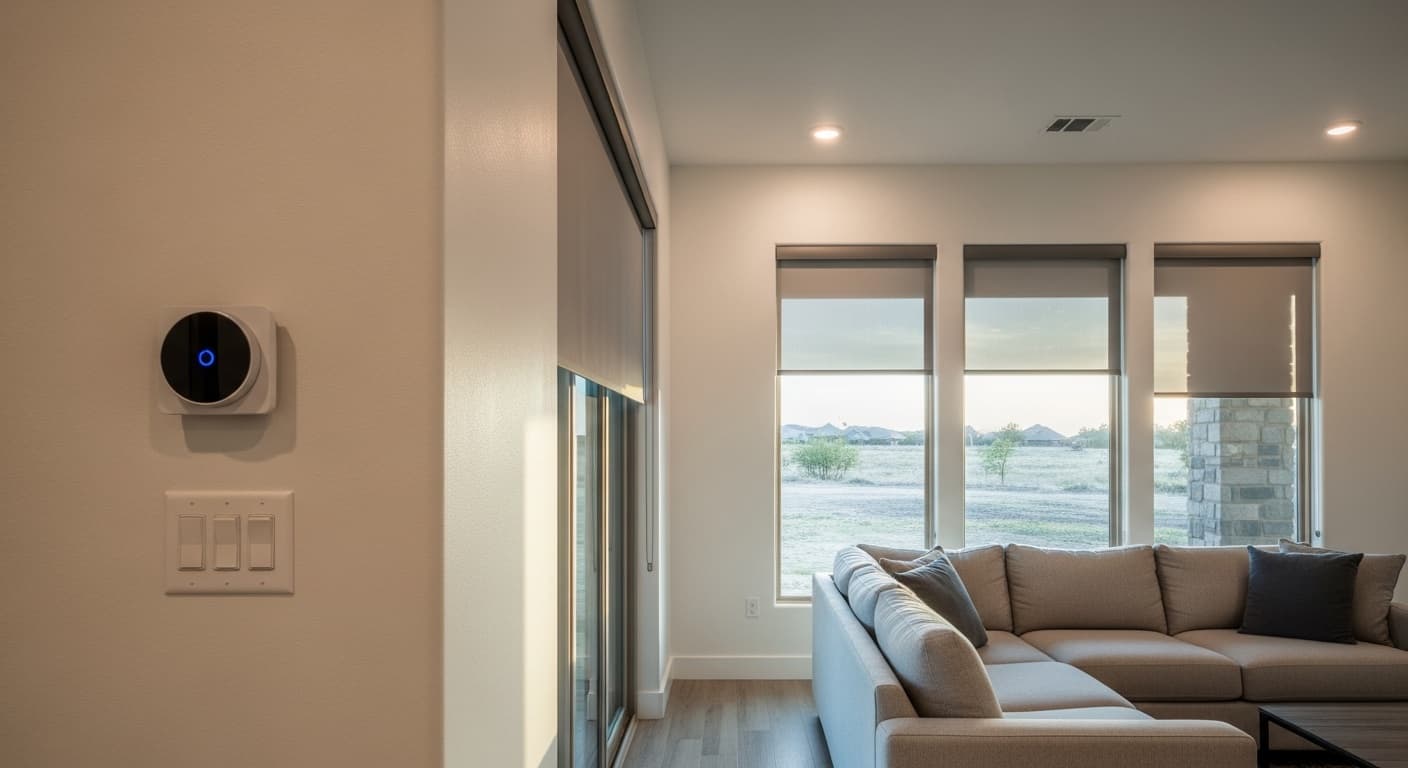
When the house needs a repipe anyway, PEX is the usual choice. It tolerates freezing better than copper, though it is not freeze-proof, and its fittings are still a weak point. Swap old spigots for frost-free hose bibs, which close the valve inside the warm wall. Then add early warning: leak sensors under sinks and beside the water heater and washer, and a main-line smart valve that sends freeze alerts and closes the water when it detects a burst. Our guide to smart home upgrades that add value compares the systems, and our smart water shutoff valve guide covers installation and sensor placement.
- Smart shutoff valve, installed
- $700 to $1,500
- Average U.S. water and freeze claim
- About $15,400
| Permanent fix | Typical Lubbock cost | What it solves |
|---|---|---|
| Frost-free hose bib | $200 to $450 each | Spigots that split behind the brick |
| Battery leak sensors | $20 to $60 each | Alerts for slow leaks under sinks and appliances |
| Main-line smart shutoff valve | $700 to $1,500 | Freeze alerts and automatic shutoff on a burst |
| Leak and freeze monitoring package | $1,000 to $4,000 | Valve, sensors, smart thermostat, and app setup |
| PEX whole-house repipe | $4,000 to $15,000 | Old galvanized or repeat-failure lines, rerouted |
Frozen Pipe Mistakes to Avoid
Most frozen pipe damage in Lubbock comes from a handful of avoidable mistakes.
- Leaving a hose connected to a frost-free bib, which traps water in the valve and can split it inside the wall.
- Turning the thermostat down to save money while you travel. TDI warns that skipping steps like keeping the heat on can cost you coverage.
- Thawing a pipe with a torch, or wrapping heat cable over insulation or over itself.
- Forgetting the backflow preventer, the most exposed piece of plumbing on most Lubbock lots.
- Not knowing where the shutoff is until water is coming through the ceiling.
- Closing up wet drywall before it is dry, or throwing out damaged items before the adjuster sees them.
A Note from Nextgen Blueprint
This guide was researched and published by Nextgen Blueprint, a Lubbock design-build contractor. Prices are 2026 budgeting ranges for the Lubbock market as of October 2026, and the real cost depends on where the pipe is and what the water reached. It is general information, not insurance advice; your policy controls your claim. Our licensed plumbers handle freeze repairs, frost-free bibs, attic reroutes, and PEX repipes, and because we are also the remodeler, we close up the drywall and finishes the repair opens. Call (806) 472-4572 for an itemized, written quote.
Frequently asked questions
At what temperature do pipes freeze in Lubbock?
Should I drip my faucets in Lubbock during a freeze?
How do I shut off my water at the meter in Lubbock?
What should I do first if a pipe bursts?
Does homeowners insurance cover frozen pipes in Texas?
How much does it cost to fix a frozen or burst pipe in Lubbock?
Can I use a space heater or hair dryer to thaw a frozen pipe?
Is a smart water shutoff valve worth it in Lubbock?
Sources and further reading
- [1]NWS Lubbock: Freeze records for Lubbock
- [2]NWS Lubbock: Record cold stretches for Lubbock
- [3]NWS Lubbock: January 23 to 26, 2026 winter storm summary
- [4]Texas Department of Insurance: Winter storms, tips for preparing your house and pipes
- [5]Texas Department of Insurance: When are water damage and mold covered by insurance?
- [6]KCBD: City of Lubbock shares tips as frozen pipes begin to thaw
- [7]IBHS: Winter Weather Ready guide news release
- [8]American Red Cross Texas Gulf Coast: Tips to prevent pipes from freezing and ways to thaw them
- [9]U.S. Consumer Product Safety Commission: Check heat tapes and cables for possible fire hazards
- [10]Texas A&M AgriLife Today: Protect livestock, plants, pipes and pets from winter weather
- [11]UpCodes: Texas residential plumbing code P2603.5, Freezing
- [12]Insurance Information Institute: Facts and statistics, homeowners and renters insurance
Written by
John Paul, Founder, Nextgen Blueprint
John Paul founded Nextgen Blueprint with his father-in-law, a Lubbock-area general contractor with 30+ years of experience. They build healthy, natural homes for Lubbock families, and approach every project with the kind of care and attention to detail most contractors save for their own home.
More from JohnRelated services
Filed under Homeowner Guides. Practical playbooks for owning a home on the South Plains.