Healthy & Smart Home16 min read
Smart Water Shutoff Valve Installation in Lubbock, TX: Costs, Leak Sensors, and Setup
What a smart water shutoff valve and leak sensors cost in Lubbock, how flow-based leak detection works, what installation involves, Wi-Fi and power needs, hard water and freeze concerns, and where to put sensors.
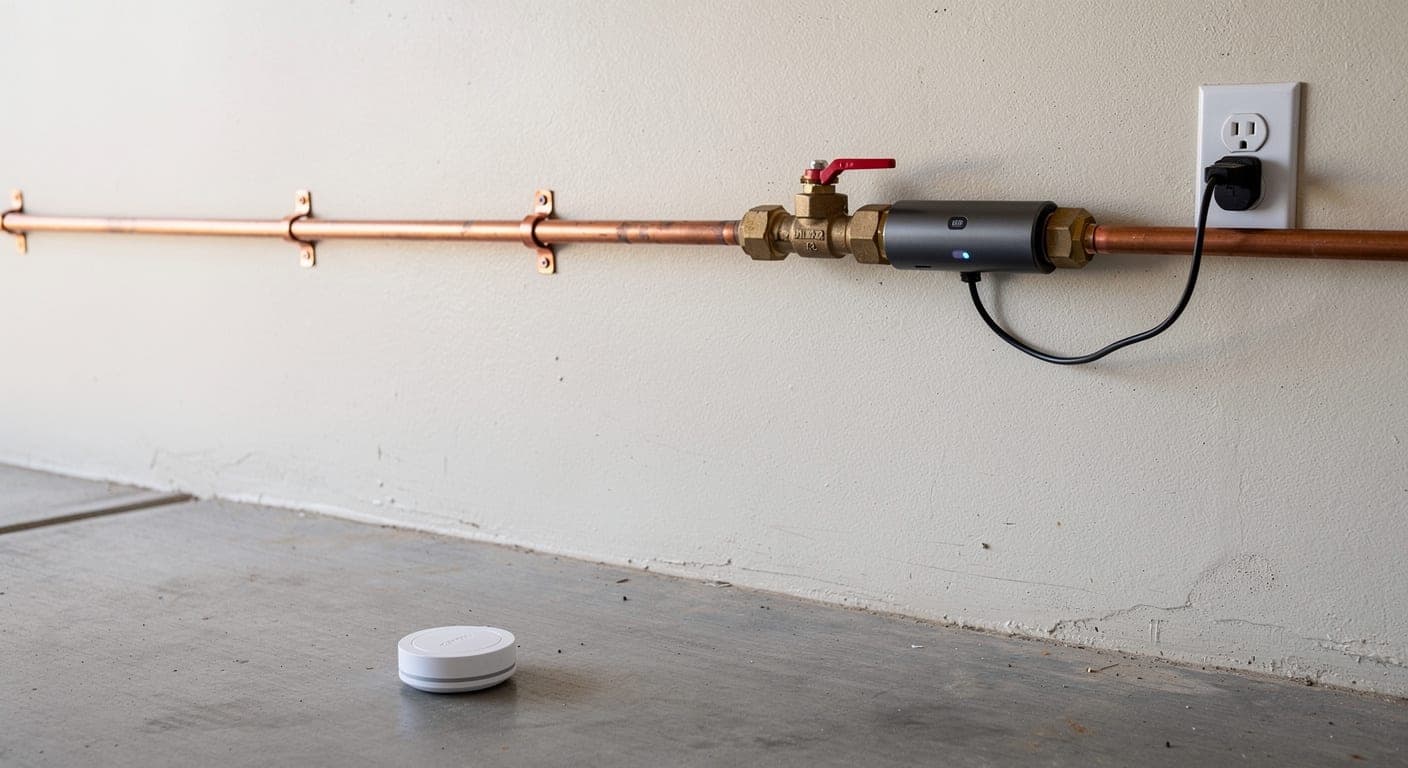
Smart water shutoff valve installation in Lubbock typically costs $700 to $1,500 for a main-line valve put in by a licensed plumber, and battery leak sensors add $20 to $60 each. The valve sits on the main water line, learns how your household uses water, closes on its own when it sees a burst-pipe flow, and runs a daily pressure test that flags hidden leaks. Point sensors under sinks and beside the water heater sound an alarm where water actually lands. Together they cover the two leaks that hurt Lubbock homes most: a pipe that splits in a hard freeze and a slow leak you cannot see. Here is how the systems work, what installation involves, what they need from your Wi-Fi and power, and where sensors belong.
On this page
- 01What Smart Water Shutoff Valves and Leak Sensors Cost in Lubbock (2026)
- 02Whole-Home Shutoff Valve vs Point Leak Sensors: What Each Catches
- 03How Flow-Based Leak Detection Works
- 04The Lubbock Factor: Freezes, Slab Leaks, and Hard Water
- 05Smart Water Shutoff Valve Installation: What the Plumber Does
- 06Permits and Who Can Do the Work in Lubbock
- 07Wi-Fi, Power, and What Happens in an Outage
- 08Where to Put Water Leak Sensors in a Lubbock Home
- 09A Worked Example: A 1970s Brick Ranch in South Lubbock
- 10Insurance: What Leak Protection Can and Cannot Do for Your Policy
- 11How to Get a Good Quote and Mistakes to Avoid
- 12A Note from Nextgen Blueprint
- 13Frequently asked questions
What Smart Water Shutoff Valves and Leak Sensors Cost in Lubbock (2026)
Leak protection comes in three tiers. Battery leak sensors are the entry point and cost little, but they only alert you. A main-line smart shutoff valve does the real work: it monitors the whole plumbing system and closes the water when something goes wrong. A full package adds sensors, freeze monitoring, and setup with the rest of your smart home.
The valve price covers the device, a licensed plumber cutting it into the main line, the adapters most installs need, and app setup. One manufacturer lists its main-line valve at $579.99 as of October 2026 and says installation typically takes one to two hours, which is why the installed price starts near $700. Costs climb toward $1,500 when the old house valve has to be replaced, the line needs rerouting for access, or an outlet has to be added near the valve.
- Smart shutoff valve, installed
- $700 to $1,500
- Battery leak sensor
- $20 to $60 each
- Typical install time
- 1 to 2 hours
| Option | Typical Lubbock cost | What you get |
|---|---|---|
| Battery leak sensors | $20 to $60 each | A local alarm and phone alert where water touches the sensor |
| Main-line smart shutoff valve | $700 to $1,500 | Whole-home flow and pressure monitoring with automatic shutoff |
| Leak and freeze monitoring package | $1,000 to $4,000 | Valve, sensors, smart thermostat, and app setup |
| Leak detection visit (no device) | $150 to $400 | Pressure testing and electronic leak location by a plumber |
Whole-Home Shutoff Valve vs Point Leak Sensors: What Each Catches
A point sensor is a small battery puck that sits on the floor. When water bridges its contacts, it beeps, and smart models also send a phone alert. It is cheap and easy, but it only knows about water that reaches that exact spot, and it cannot stop anything. If you are at work or out of town, the water keeps running until someone gets home.
A whole-home valve installs on the main supply line and watches every pipe after it: supply lines inside walls, the line under the slab, the water heater, and every fixture. It can close the water itself. Some systems pair wireless sensors with the valve, so a wet sensor can close the water too, which is the strongest setup. For most Lubbock homes the right answer is both: the valve for the whole system and a handful of sensors at the appliances most likely to fail.
| Feature | Point leak sensors | Main-line smart valve |
|---|---|---|
| What it watches | Only the spot where it sits | Every pipe and fixture after the valve |
| Stops the water | No, unless paired with a valve | Yes, automatically or from the app |
| Catches a leak inside a wall or slab | Only if water reaches the sensor | Yes, through flow and pressure changes |
| Freeze warning | Some models report room temperature | Many models report water temperature |
| Installation | Set it on the floor and pair it | A plumber cuts it into the main line |
| Power | Battery, often 2 years or more | Wall outlet, often with no battery backup |
How Flow-Based Leak Detection Works
Smart valves use three tools. The first is a learning period. Moen says its system spends the first 7 days of water use building a picture of your household, and that alerts and automatic shutoff turn on once that learning is done. After that, it keeps adapting as your habits change.
The second is high-flow shutoff. When water runs far longer or harder than your normal pattern, the valve sends a critical alert, and if no one clears it, closes the water. In Moen's example, water running well past a household's usual 30 minute shower pattern draws a critical alert, and the valve closes if no one clears it. Sensitivity is adjustable, so a home with a long irrigation cycle can set it to act only on major events.
The third is a pressure test, which finds leaks too small to register as flow. Once a day, during hours you are unlikely to use water, the valve closes and watches the pressure in your pipes for several minutes. If pressure holds, the plumbing is tight. If it drops, something is leaking. Moen says its test can detect a drip as slow as one drop per minute, and Phyn offers a similar Plumbing Check that it says finds pinhole leaks in minutes.
The Lubbock Factor: Freezes, Slab Leaks, and Hard Water
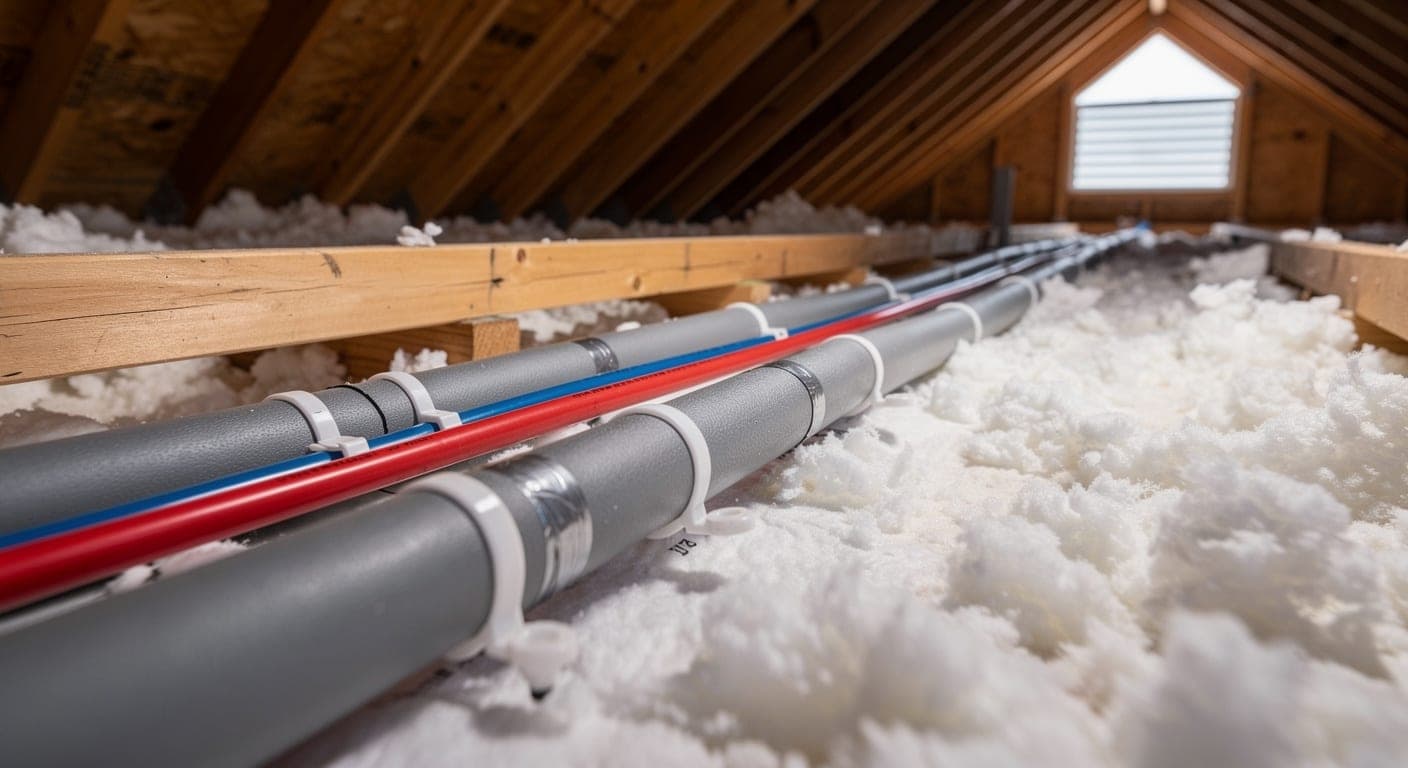
Freezes are the headline risk. Lubbock does not freeze often, but a hard freeze can split a pipe in an attic or exterior wall, and the leak starts when the ice thaws, often while you are at work. A smart valve closes on the burst flow, and many models also send a warning when water temperature drops toward freezing. IBHS advises keeping the thermostat at 55 degrees or higher even when no one is home, and closing the main if you will be gone more than a week in freezing weather, which a smart valve lets you do from your phone. Our guide to frozen pipes in Lubbock covers where pipes freeze and what to do first.
Slab leaks are the quiet risk. Many Lubbock homes sit on slabs with supply lines underneath, and a leak there can run for weeks with no visible water. No floor sensor will see it, but the daily pressure test can, because a leak anywhere after the valve makes the pressure fall. If the test keeps failing and every fixture checks out, call for leak detection before the water reaches the clay under the foundation.
Hard water is the maintenance risk. Lubbock water averaged 169 ppm of hardness (about 10 grains per gallon) in the City's 2025 report and 192 ppm in 2024, which is hard. Minerals and years without use can leave an old main valve stiff, so test it before adding a clamp-on motor. A valve that closes for a daily pressure test is exercised every day, which helps it keep moving. And a water softener belongs after the smart valve, so the valve protects the softener and its connections too.
- Lubbock hardness, 2025 City report
- 169 ppm, about 10 gpg
- IBHS minimum thermostat in a freeze
- 55 degrees
Smart Water Shutoff Valve Installation: What the Plumber Does
There are two kinds of valves. An inline valve replaces a short section of your main line with a motorized valve and its sensors, so it measures flow and pressure directly. A retrofit actuator clamps onto your existing ball valve and turns its handle with a motor. Retrofits avoid cutting pipe, but they depend on the old valve, and they usually rely on paired sensors or the app to decide when to close. A stiff gate valve is not a good candidate. Moen recommends a professional for its inline valve because installation requires removing a section of the main pipe, and Phyn recommends a licensed plumber. A typical inline install goes like this:
- Find the main line and measure it. Phyn's valve fits main lines up to 1 1/4 inches, and its 1 inch threaded ends often need adapters.
- Choose a spot after the house shutoff and before the first branch, including irrigation, the softener, and the water heater, so the valve protects everything inside.
- Confirm there is an outlet within reach of the power cord, or plan a new one, ideally GFCI-protected in a garage.
- Shut off the water, cut in the valve with the right adapters and unions, and support it so its weight is not hanging on the pipe.
- Restore water, check for leaks, and confirm the manual override opens and closes the valve.
- Connect it to Wi-Fi, pair any leak sensors, set alert contacts, and run the first pressure test.
- Live with it for the learning week, then tune the sensitivity so it acts on real events and stays quiet for normal use.
Permits and Who Can Do the Work in Lubbock
Cutting into the main water line is plumbing work. The City of Lubbock's Building Safety FAQ says plumbing permits may be issued to homeowners who own and live in the house as their homestead, with the work done by the homeowner or an immediate family member. On a rental, plumbing permits must be pulled by licensed subcontractors, and the City notes a licensed master plumber must be in responsible charge of permitted work. Lubbock has adopted the 2021 International Plumbing Code.
Ask your plumber whether your scope needs a City permit, especially if the job includes a new house valve, rerouting the main, or a new circuit for the outlet. If you hire the work out, the plumber should be licensed with the Texas State Board of Plumbing Examiners. A clamp-on actuator that does not open the line is closer to a smart home device install than a plumbing job, but the valve under it still has to work.
Wi-Fi, Power, and What Happens in an Outage
Most smart valves live in a garage or on an exterior wall, which is often the weakest Wi-Fi spot in a brick house. Moen's valve is designed for a 2.4 GHz network. Phyn requires Wi-Fi at the install location and suggests a repeater or extender if the signal is weak. Check signal strength at the valve location with your phone before installation day. Our guide to smart home upgrades covers home Wi-Fi and wiring in more detail. If your router combines 2.4 and 5 GHz under one name and a device will not join, your internet provider can help you split them.
Power matters more than most people expect. Moen's valve needs a nearby outlet, and the company sells a 25 foot extension cable for outlets more than 10 feet away. Phyn ships a 12 foot cord and recommends a GFCI outlet. Phyn says that during a power loss its valve stays in its last position, so it will not close on its own until power returns, though a manual tool can close it. If outages are common on your street, ask about a small battery backup for the outlet.
Losing internet is less serious than losing power. Moen's Local Mode instructions say the valve still shuts off the water automatically when its thresholds are met without Wi-Fi, but you lose phone alerts and remote control until the connection returns.
Where to Put Water Leak Sensors in a Lubbock Home
Put sensors where water appliances and supply lines can fail without anyone seeing them, on the floor at the lowest point, where water will reach first. Six to eight sensors cover most houses. Moen's detectors run on one CR123A battery that typically lasts more than two years, depending on the temperature and humidity alerts you set, and the app warns you when it runs low. These are the spots worth covering, roughly in order:
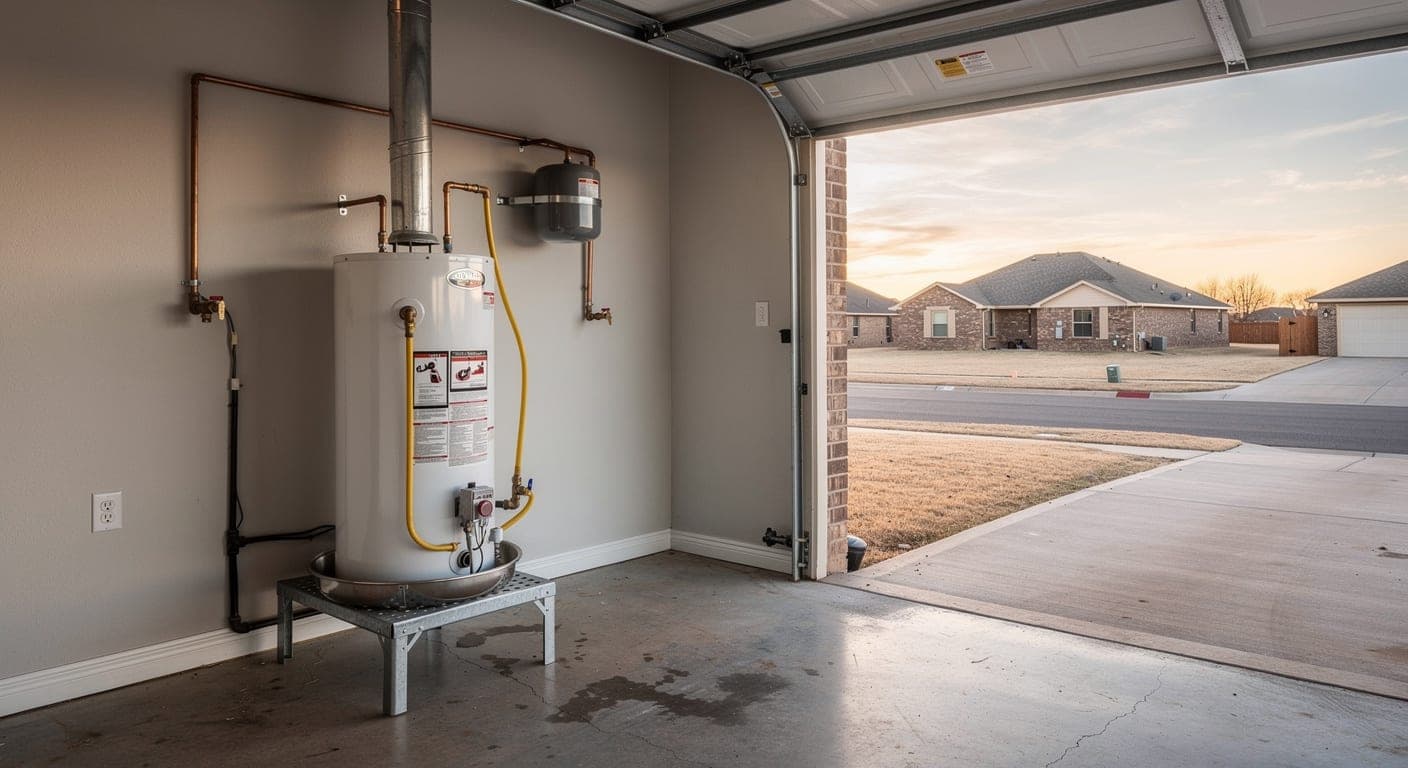
- Water heater: in the drain pan or on the floor beside the tank. Tanks fail with age, and an attic or closet water heater can flood rooms below.
- Washing machine: behind it, near the supply hoses, which are a common failure.
- Kitchen sink: under the sink by the dishwasher supply, the disposal, and any under-sink reverse osmosis unit.
- Refrigerator: behind it if it has an ice maker or water line.
- Bathroom sinks and toilets: at the toilet supply line and in each vanity.
- Water softener: beside the tank and brine tank, where a stuck valve or loose fitting can run for hours.
- HVAC air handler: in the attic or closet pan, where a clogged condensate line overflows in the long cooling season.
- Attic or exterior walls: a temperature sensor near pipes that froze before gives early freeze warning.
A Worked Example: A 1970s Brick Ranch in South Lubbock
Take a 1,800 square foot brick ranch with a 3/4 inch main entering the garage, a 50 gallon gas water heater in the garage, a softener, two bathrooms, and an irrigation system tied in near the meter. The old gate valve in the garage is stiff, so the plumber replaces it with a ball valve and cuts the smart valve in right after it, ahead of the softener and water heater. An outlet is already on the garage wall.
The smart valve lands at about $700 to $1,500 installed, and this house sits in the middle of that range because of the extra house valve. Six sensors, at the water heater, washer, kitchen sink, softener, and both bathrooms, add $120 to $360. The total runs about $820 to $1,860. One detail matters here: the irrigation tee sits before the smart valve, so a broken sprinkler line will not trip it. That is a reasonable trade-off, because a yard leak does not flood the house, but the backflow preventer still needs winter care.
- Smart valve, installed
- $700 to $1,500
- Six sensors
- $120 to $360
- Example total
- About $820 to $1,860
Insurance: What Leak Protection Can and Cannot Do for Your Policy
Water damage is one of the most common home insurance claims. The Insurance Information Institute puts water damage and freezing at about 1.5 claims per 100 insured homes a year, averaging about $15,400 per claim from 2019 to 2023, though those national figures leave Texas out of the sample. The EPA estimates the average household's leaks waste more than 9,300 gallons a year, and nine percent of homes have leaks wasting 50 gallons or more a day.
The Texas Department of Insurance says most home policies cover sudden and accidental water damage, such as a burst pipe, but usually not gradual leaks, and hidden damage usually has to be reported within days of when you first see it. That is where early detection pays: a valve that flags a slow leak in its first days can keep it from becoming the kind of gradual damage a policy may not cover. Speed matters for mold too. The EPA says water-damaged areas should be dried within 24 to 48 hours to prevent mold growth.
Some insurers have offered premium credits or discounted devices for leak detection, but we could not confirm a current program for Texas policies on any carrier's own site as of October 2026. Ask your agent directly whether a discount applies, whether it requires an automatic shutoff valve rather than alarms alone, and what proof of installation they need. This is general information, not insurance advice, and your policy controls.
- Average U.S. water and freeze claim
- About $15,400
- Average household leak waste (EPA)
- More than 9,300 gallons a year
How to Get a Good Quote and Mistakes to Avoid
A good quote names the valve model and size, where it will go relative to the house shutoff, irrigation, softener, and water heater, whether the old house valve is being replaced, the adapters and supports, the outlet plan, and who sets up the app and sensors. Ask whether the plumber will walk you through the manual override and the first pressure test. These are the mistakes that undo a good system:
- Putting the valve after a branch, so the water heater or softener is not protected.
- Mounting it where Wi-Fi barely reaches, so alerts arrive late or not at all.
- Clamping an actuator onto a stiff gate valve that will not seal when the motor turns it.
- Leaving the system in sleep or pause mode after filling a pool or watering the yard.
- Buying sensors that only beep, with no phone alert and no link to a shutoff valve.
- Ignoring a failed pressure test for weeks. A repeat failure with every fixture off is a reason to call for leak detection.
- Forgetting the batteries. Put sensor battery changes on the same calendar as smoke alarm checks.
A Note from Nextgen Blueprint
Prices in this guide are 2026 budgeting ranges for Lubbock as of October 2026, and your real price depends on your main line, the valve you choose, and what is already in place. Product details come from manufacturers' published specifications and can change. Our smart home team designs leak and freeze monitoring that ties into the rest of your system, and our plumbers install the valve and fix what the system finds. Call (806) 472-4572 for a written, itemized quote.
Frequently asked questions
How much does it cost to install a smart water shutoff valve in Lubbock?
Can I install a smart water shutoff valve myself?
Does a smart water shutoff valve work without Wi-Fi or power?
Will a smart water shutoff valve detect a slab leak?
Where should I put water leak sensors?
Do insurance companies in Texas give discounts for water leak detection?
Does Lubbock's hard water damage a smart shutoff valve?
Do smart water shutoff valves need a monthly subscription?
Sources and further reading
- [1]Moen: Understanding your MicroLeak test
- [2]Moen: FloSense, explained
- [3]Moen: How to use the Local Mode
- [4]Moen: Flo Smart Water Monitor and Shutoff support
- [5]Moen: How long will Moen Flo Detectors last?
- [6]Phyn: Phyn Plus Smart Water Assistant and Shutoff (2nd Gen)
- [7]U.S. EPA WaterSense: Fix a Leak Week
- [8]U.S. EPA: A brief guide to mold, moisture, and your home
- [9]Texas Department of Insurance: When are water damage and mold covered by insurance?
- [10]Insurance Information Institute: Facts and statistics, homeowners and renters insurance
- [11]City of Lubbock Building Safety: Frequently asked questions
- [12]IBHS: Winter Weather Ready guide news release
Written by
John Paul, Founder, Nextgen Blueprint
John Paul founded Nextgen Blueprint with his father-in-law, a Lubbock-area general contractor with 30+ years of experience. They build healthy, natural homes for Lubbock families, and approach every project with the kind of care and attention to detail most contractors save for their own home.
More from JohnRelated services
Filed under Healthy & Smart Home. Cleaner water, cleaner air, better light, smarter systems.